function jdb_page_navigation()
sPageSlug = blog
sPageTitle = easily amused
header:139:aPageArgs:page_title = easily amused
header:140:aPageArgs:section_title =
functions-johndberry:262:aPageArgs:page_title = easily amused
functions-johndberry:298:sPageTitle = easily amused
functions-johndberry:359:sPageTitle = easilyamused

easilyamused |

Archive for the category ‘typography’

Hanging by a serif

Published

Recently I published a little booklet called Hanging by a serif: a few words about designing with words. This is the culmination of a project I’ve been working on, off and on, for more than a year: pulling a selection of statements about typography and design from my own writing and presenting them, one to a page, along with a simple decorative element. The hook – quite literally, in some cases – is that those visual elements are all enlarged details of serifs, taken from a wide variety of typefaces. (You’d be surprised how much alike the serifs look on a lot of otherwise distinctive typefaces, when you blow them up in size and cut off the rest of the letter.) I had fun with this, as you might imagine. The hardest part was forcing myself to edit or rewrite my own words, to make them more appropriate to this format and purpose. It was also difficult choosing the quotes, and picking the serifs, but that was the kind of task that you can only revel in: a richness of choice.

One early recipient of a digital version, Scott-Martin Kosofsky, unexpectedly suggested that I “may have invented a new genre, design maxims, making you a kind of typographic Rochefoucauld.” I certainly doubt that my little booklet will go through as many editions and revisions as La Rochefoucauld’s Maximes, but I’ll be happy if it finds a use in the hands of its readers.

For an early draft, which I wanted to take with me on a visit to San Francisco to show to Jack Stauffacher and others at one of his weekly Friday lunches, I had trouble getting the booklet to print properly as page spreads, so I just printed the pages individually and bundled them into a wrap-around folded cover, just to suggest how it might all work as a booklet. What that inadvertant format showed me, however, was that these pages could also work singly, as individual cards. The actual content of those pages has undergone a good bit of revision since that San Francisco trip, but this is the reason why I’m offering Hanging by a serif both as a saddle-stitched booklet and as a set of cards.

When I showed a version of the cards to Juliet Shen at one of our local typographers’ pub gatherings, her immediate thought was, “I could give each of my students one of these and have them do a project based on it.” I hadn’t thought of that; perhaps they have a future use as a teaching tool. (You be the judge.)

This is the “first iteration” of Hanging by a serif; I’m sure it will evolve and appear draped in other clothes. Right now, you can buy the booklet or the cards from the newly created Shop page on this website, and they will undoubtedly be available through other sellers eventually. I sold a few at TypeCon in the SOTA store, and I expect I’ll have at least a few with me at next month’s ATypI conference in Amsterdam. Or you can use PayPal to buy a copy right here, and have me send it to you directly. (If you’re interested in a larger quantity, just send me e-mail at john <at> johndberry <dot> com and let me know.)

iOS7 typography: too thin, too tight

Published

Everything about the new design of iOS that was previewed this week looked nifty, except for the typography. Okay, I’m not wild about the candy colors, but that’s just taste. Typography isn’t just about taste; it’s about functionality. On the screen, and for information design, Helvetica – whether Neue or not – is not functional; it just gives the flavor of functionality. The letterforms are too closed, too uniform; they’re not easy enough to distinguish at a glance. And a glance is exactly what we give to the screen of our phone.

At huge size, the Helvetica Neue Thin numbers look all right; but at any other size, they lack clarity. It’s too easy to mix up a 3 and a 6 and an 8 and a 0, at small sizes – not a problem you really want to have when you’re dealing with dates and coordinates and addresses and phone numbers.

Please, can we have a moratorium on very thin sans-serif type that’s pushed tightly together? Trying to squeeze more information into a small space is useless if the information isn’t clearly readable. The lighter the weight of a typeface, the more space it needs between letters, to be easy to read. And it needs even more space when the text is displayed against a dark or mottled background, or seen at an angle rather than straight on. All of which is inherent in the iOS7 design.

For that matter, I wonder whether, in the age of Apple’s Retina display, there’s any need to stick with sans-serif faces on the screen. For years, I’ve felt that an open humanist sans was the most functional style of typeface for reading onscreen; but perhaps that’s no longer true. Or at least not necessarily.

Everything that Jony Ive says about design in his iOS7 video is true. Unfortunately, in the typography of the visual interface, he hasn’t followed through. What we’ve seen is only a preview; the UI is still in development, and it could change for the better before it’s released. But I know how the process of software development goes, and I’m sure there’d be a huge resistance to any change at this point that affected how much text fits on the screen. It’s disappointing, because a fundamental rethinking of the typography is what’s needed.

Some examples:

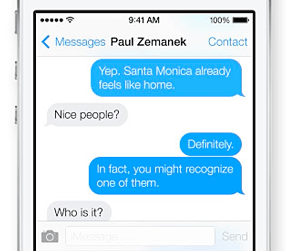
Can you read this exchange easily? Not “can you make it out when you squint and peer closely,” but can you read it easily?

Messaging in iOS7

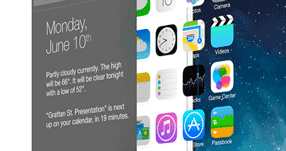
What’s on your calendar for June 10? (And what’s with that busy superior “th,” anyway? That’s 18th-century design, not 21st.) Can you read it when you see it at this angle?

iOS7 interface at an angle

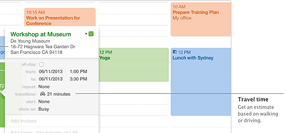
Ironically, Apple’s marketing typeface is much more readable than its iOS text face. The callouts in this example are clearer than the information in the Calendar panel.

iOS7 Calendar with callouts

[Images at left: top, part of a screenshot of a message from Siri in iOS7; below, the same words in a few different of typefaces, with looser spacing.]

Addendum (July 8):

Apparently the latest beta of iOS7 allows switching to Neue Helvetica Regular instead of Light for non-Retina displays. Gizmodo has a nice demo of the effect. (Thanks for pointing this out, Aaron Meek.) Alas, it’s clear when you see the font switching back and forth that somebody at Apple doesn’t understand how to track lighter typefaces so they’re readable. The lines of lighter type should be at least as long as the lines of heavier type, not shorter. Squeezed again!

The Briem Report

Published

Last year, after a highly entertaining turn as the keynote speaker at the ATypI conference in Reykjavík in 2011, designer and lettering artist Gunnlaugur SE Briem asked around 100 practitioners of lettering or typography to contribute a two-page spread each to a new compendium, The Briem Report: Letterforms 2012. I was pleased to be among those invited to participate. The resulting volume was published earlier this year as a freely downloadable PDF, and recently Briem sent printed copies to all the contributors. (I recommend the print-quality PDF, as the hard copy is a black-and-white print-on-demand edition; you can order it from Amazon and it’s wonderful to have, but I consider the core edition to be the digital one.)

Briem did something similar once before, in 1986, when he edited and produced a book for Thames & Hudson called Sixty Alphabets, asking sixty noted calligraphers to introduce themselves and their work and to contribute a design of their own choice. That in turn had been inspired by a much earlier compendium, Dossier A–Z 1973, which had been put together in 1973 by Fernand Baudin for that year’s ATypI congress in Copenhagen, on the theme of “Education in the Design of Letter Forms.” Both Baudin’s 1973 volume and Briem’s 1986 one examined the place of written letter forms in a world dominated by print. The Briem Report takes this one step further: what is the place of both calligraphy and type design in a world that’s becoming thoroughly digital? Baudin was looking at the changing nature of type and letter design in 1973; Briem is asking much the same question today.

The answers are all over the place; there is no one thesis to be found in this anthology. But as a snapshot of current practice and ideas, it’s invaluable. The contributors include most of the people you might expect, and many that you might not be aware of; Briem drew from many different streams of practice. Some are artists, some are technical experts, many are educators. As Briem describes the book, aptly (and in thoroughly Briem fashion), on his Operina website: “Inspiring ideas, firm convictions, lovely dreams.”

The Magazine & I

Published

There’s something curiously recursive about linking to a website to read an article I wrote for an app-based magazine. But happily, The Magazine has just expanded its subscription base from its iOS6 app to include web subscriptions; and even non-subscribers can access and read one full article each month. (Other links that month will just show previews: the first couple of paragraphs.) So you can go right now and take a look at “Unbound pages,” my article about the typography of reading onscreen, in the Mar 28 issue.

I questioned the initial limitation of The Magazine as an iOS-only app (indeed, one that requires iOS6, which lets out older iOS devices like my first-generation iPad). But what that limitation did was focus squarely on a specific audience: tech-savvy readers who are likely to be early adopters and who work or play in one of the creative fields (which tilt strongly toward Apple’s digital ecosystem). It also meant that the app itself could be clearly and simply designed.

While there’s a difference between how the app displays an issue on an iPhone and on an iPad, the basic typographic treatment is fixed; the only real change appears if you shift the orientation, which affects how long the lines of text are. (This is all directly related to what I was writing about.) The display of the articles on the website is similarly simple and limited, but by the nature of current web-design tools (again, directly related!) it’s less typographically sophisticated, less well adapted to the screen “page.” But you can subscribe to the web version even if you don’t own an iOS6 device; that expands the potential readership.

With the current update to The Magazine’s software, you can also link, as I’ve just done, to a single article that a non-subscriber can read in its entirety, along with previews of other articles in the issue. That “porous paywall” is a smart marketing move: it encourages dissemination of material from The Magazine without giving it all away. (And the terms of The Magazine’s contracts are that they’re only buying one month of exclusivity anyway; authors can do anything they want after that first month, including posting the article for free on their own website or broadcasting it to the entire world. This seems like a model that’s well adapted to the realities of current online publishing.)

Go ahead and subscribe. There’s a bunch of other good material in the new issue, and I expect that I’ll write for The Magazine again.

[Image: detail of one of the illustrations done for my article by Sara Pocock.]

Hong Kong images

Published

After an absurdly long delay, I have finally put some of my photos from last October’s ATypI Hong Kong up on Flickr: here. Although I didn’t take a lot of snapshots, there are few images there that ought to be interesting to people who weren’t there – and to some of the people who were. In particular, I got to the very first letterpress workshop at Zi Wut, which contains the type and printing press from a former printshop in Kowloon, now operated by three women as a teaching resource, with the original owner of the printshop offering examples and showing how the processes worked. Zi Wut has a presence on Facebook, and there’s a nice short write-up, with more images, on the Metropolis magazine blog.

Funny shapes

Published

At TypeCon in Milwaukee at the beginning of this month, Cyrus Highsmith gave a witty, illustrated talk about spacing in text typography, which served as an introduction to his new book, Inside paragraphs: typographic fundamentals (published by Font Bureau). It startled me, because I hadn’t been aware that he’d been working on such a book, and because it dovetails with what I’ve been talking and writing about for quite some time: that typography is all about space. Appropriately enough, though without any planning on my part, my former colleagues at Microsoft had brought stacks of one of my little typography booklets, Arranging fonts: it’s all about space, which is about exactly that.

Cyrus focused on the paragraph as the basic unit of text typography, which is a sensible way of looking at it; that neatly separates what Jost Hochuli calls “microtypography” from the “macrotypography” of the page. And Cyrus can draw a lot better than I can, so his illustrations – both in the book and in his talk – make his points brilliantly and lucidly.

The book itself is small, light, and oblong – very easy to carry around and read, with long paper flaps that you can use to mark your place. Cyrus wrote it because he wanted it for the typography classes that he teaches at RISD; and because he wished that he’d had it when he was studying design. It’s probably a good introduction to the subject for graphic-design students, but even more than that, it’s a basic explanation for anyone who uses type and wonders why it sometimes looks right and sometimes doesn’t.

Edgy trust

Published

I’ve done a number of projects with Seattle poet JT Stewart over the last few years: two chapbooks, a bunch of broadsides, promotional materials for events, and the workshop that we’ve taught together for poets who want to turn their poems into broadsides. Most recently, JT’s work was selected for a display of literary and visual works that came out of Artist Trust’s EDGE program, a “professional development program” for artists. The exhibit, called “A Celebration of Washington Artists,” is on display at the Washington State Convention Center in downtown Seattle until October 18. Most of the work on the walls is paintings, prints, photos – visual art – but interspersed among them are poster-size displays of some of the writing that has come out of the program. Since the poems of JT’s that got selected came from the chapbook Love on the Rocks – Yet Again, which I designed and produced, I created a visual display for them as part of this exhibit. Two of the four panels are the front and back covers of the chapbook (the back features a highly visual poem); the other two are poems from the body of the book, presented in a format that I thought would be eye-catching and readable on a public wall.

When I stopped by the WSCC on the first day of the exhibit, I could spot our installation immediately from the escalator. On the way back down, I caught a snapshot of someone already stopping to read the poems.

Copper Canyon e-book potlatch

Published

On Wednesday I was in Port Townsend for an “E-book Potlatch” at Copper Canyon Press. The press is housed in one of the old wooden buildings at Fort Worden, a former military base turned into a state park and cultural & arts center; Copper Canyon has been there since the 1970s, publishing some of the best in modern and international poetry. Right now they’re figuring out how to bring their backlist (and their front list) into e-book format alongside their printed books – and how to do it right. Consortium, the independent-books distributor, and the “e-book aggregator” Constellation (both part of the Perseus Books Group) sent three people to this planning meeting; according to Consortium’s Michael Cashin, Copper Canyon is on the cutting edge of creating readable e-books for poetry.

For five years in the ’90s, I was the designer for Copper Canyon’s books and collateral, and I’ve done a few projects since then, but my only current connection is as a friend and supporter of the press. Still, e-book typography is what I’ve been thinking about for the past year, so it made sense to participate in the meeting. I was impressed by the level of thinking and planning that was already going on. Both Copper Canyon and Consortium are committed to finding good ways to get books into practical e-book form right now, for immediate sale, and at the same time to developing formats that will be true to the unique demands of poetry and the future demands of technology. It’s not an easy task, but it’s well worth doing. This is an essential part of our culture.

The all-day summit was productive but exhausting. At the end of the day, Copper Canyon hosted a cook-out on the beach at Discovery Bay, where executive editor Michael Wiegers cooked up clams and prawns and salmon, and a few bottles of wine were drunk. It was one of this summer’s rare warm, sunny days, and some of the madder members of the crew ran out into the cold, cold water for a refreshing dip. That’s how the future of publishing happens.

[Photo: Michael Wiegers (left) and me on the beach at Discovery Bay. Photo by Valerie Brewster.]

Jack Stauffacher: Master of Types

Published

If you’re in San Francisco on June 15, I suggest that you drop by Swissnex, 730 Montgomery, between 6:30 and 9:30 p.m. to hear Jack Stauffacher in conversation with his friends. I’ve written plenty of times about Jack, who simply calls himself a printer but in fact carries on the cultural traditions of centuries of printing and learning through his practice of the printer’s trade (and, not incidentally, his practice of talking and thinking and encouraging others to do the same in his company). If I weren’t going to be in Yerevan for Granshan 2012 next week, I’d be sorely tempted to bop down to the Bay Area for the event.

This evening marks the close of “Types We Can Make,” an exhibition at Swissnex of “new typographic works from Switzerland.”

Swissnex is conveniently located just up the street from William Stout Architectural Books, which is a dangerous place to enter if you’re a bibliophile, especially if your vulnerability is in the line of architecture, typography, or graphic design. You’ve been warned.

New: Check out this very nicely done short video of Jack talking about his creative working methods and interacting with people at last week’s event.

[Photo: Jack Stauffacher at the AIGA National Design Conference in Vancouver, B.C., October 2003.]

TYPO in SF

Published

Last weekend I was in San Francisco for TYPO SF, the first episode of FontShop’s ongoing series of Typo conferences to be held in North America. I’ve written about it, briefly, for the Eye magazine blog, but of course there’s always more to say.

The only other Typo conference I’ve been to was Typo Berlin, back in 1999. There’s plenty of continuity, of course, starting with the fact that the overall organizers are the same (though the hands-on organizers, Michael Pieracci and Meghan Arnold, were local, and no doubt too young to have organized a type conference thirteen years ago; they certainly seemed to know what they were doing, though). Deeper continuity and context was provided on Friday afternoon by Neville Brody, who put the whole event into perspective by referring to Typo’s antecedents in the first FUSE conference, in London in 1994, and the second one, right there in San Francisco in 1998. I heard echoes of some of the themes and ideas that I remembered hearing from Neville and from Jon Wozencroft in those heady days, though perhaps with less of the stirring call to arms. (I had to leave before the end of Neville’s talk, but if there was any overt barricade-storming, I didn’t hear about it later.)

Erik Spiekermann, Jan Abrams, and Kali Nikitas took turns with the mastering of ceremonies, presenting a seamless front end; I know that both Kali and Jan took pains to find out context and interesting insights for the speakers they didn’t already know, and I think that care paid off in how well integrated it all felt to the audience.

From a speaker’s perspective, I can say that TYPO SF was very well organized. There is inevitably a divide between the speakers and the audience, more so than at a smaller professional conference like ATypI or TypeCon, but I felt it less this time than I remember feeling at Typo Berlin. There was a lot of interaction, good conversation, and sparking of fresh ideas. I know I came away from Typo SF with some new contacts and a lot of new energy.

[Photo: a snapshot taken by Chuck Byrne during my talk]