function jdb_page_navigation()
sPageSlug = blog
sPageTitle = easily amused
header:139:aPageArgs:page_title = easily amused
header:140:aPageArgs:section_title =
functions-johndberry:262:aPageArgs:page_title = easily amused
functions-johndberry:298:sPageTitle = easily amused
functions-johndberry:359:sPageTitle = easilyamused

easilyamused |

Archive for the category ‘typography’

Traveling & listening & talking: Typo Day

Published

“I can’t believe this is your first time,” said the young Indian woman with whom I was sharing the auto-rickshaw.

“It is, though,” I replied, calmly clutching a handhold as the three-wheeled vehicle careered through the traffic of northern Mumbai.

I hadn’t even encountered yet the full roar of the city, but Indian traffic was proving to be everything I had expected it to be. Chaotic, crowded, incredibly varied, and resoundingly effective at getting everyone around, despite the lack of any perceivable patterns. Drivers seemed to navigate by echo-location, honking fairly constantly to let other drivers know that they were approaching; and they might approach from pretty much any direction, or any side. Lanes, although clearly marked, were completely ignored, and each participant in the mêlée of Mumbai road traffic claimed possession of every inch of available space, whether occupied or not. Private cars predominated, but alongside them you’d find gaily decorated trucks, flitting motorbikes, daredevil pedestrians, and of course swarms of putt-putting auto-rickshaws, all punctuated with occasional feral dogs and meandering cattle.

I was in Mumbai for only a few days, invited as a keynote speaker at Typography Day 2015, an annual event that moves around among various Indian universities. This year it was being held at its original home, IIT Bombay, or the Indian Institute of Technology Bombay. The large, leafy campus lies on the northern fringe of Mumbai, abutting the shore of Powai Lake and at the southern tip of the vast hilly Sanjay Gandhi National Park. The university has about 8,000 students in a variety of faculties, clustered throughout the campus; many of the central buildings are aligned along a covered open-air walkway known as the Infinite Corridor. Although the campus feels considerably less crowded than the heart of Mumbai, and it suffers much less from the ever-present air pollution, proximity to the national park requires signs like one I saw near the lake warning that a panther had been spotted in the vicinity. “Well,” as one local put it to me, “we’re encroaching on their territory, so why wouldn’t they came into ours?”

Typo Day was put on by the Industrial Design Center, the design school at IIT, and the talks were presented in the IDC’s large, modern auditorium. Outside the auditorium was a large common area where people could mingle during the breaks for the aptly named “tea and networking,” and just outside the building, a display of typographic posters was hung in the open air and a sculptural assemblage of 3D Indian letters climbed one of the twisting trees.

The displays, like the subjects of talks and workshops, were not only multilingual but multi-script. India is a land of many languages and many writing systems; Hindi is simply the largest, and the dominant one in northern India, but the only common language that educated Indians have throughout the country is English. Although most of the various Indian writing systems are somehow related to Devanagari, the complex script developed for ancient Sanskrit and used today for Hindi and several other North Indian languages, the relationship is tenuous enough that only scholars can really spot the similarities. As one Hindi-speaking designer from Mumbai put it, “If I go to Bangalore, I can only admire the writing there as shapes; I cannot read it.” Several of the talks at Typo Day dealt with the fine points of Devanagari type designs and manuscript traditions; others dealt with different writing systems, including one talk by a woman from Sri Lanka, Sumanthri Samarawickrama, about the lack of vocabulary to describe the letterforms of written Sinhala.

But it wasn’t just fine points and details. There was exuberant creativity on display, and the other keynote speaker, Itu Chaudhuri, gave an inspiring and well-illustrated talk about how a love of letters “will enrich your life.” He then proceeded to demonstrate how it had enriched his.

I was treated extremely well by the organizers of Typo Day, Prof. Ravi Poobaiah and his wife, Dr. Ajanta Sen. Not only did they fly me to Mumbai, have students meet me at the airport when my flight arrived in the middle of a hot March night, and put me up in the comfortable Guest House at IIT, but on the day after the end of the conference they arranged a car and driver for me to explore Mumbai (and its traffic), and the next night they had me staying at the Royal Bombay Yacht Club, which is every bit as luxurious as it sounds. We had met there for dinner the night before, but, as Ravi explained, there wasn’t a room available that night, so they drove me back to IIT, with Ajanta giving me a running commentary on the history of the heart of the city and which buildings she had grown up in.

At the conference, I found myself being naturally adopted into the circle of gray-haired elders of Indian design, though I also met quite a few younger designers and students. Although I often missed the jokes, sometimes from lack of context, sometimes from not catching the accents, I enjoyed the company of these men and women with their shared history of typography and graphic design in India. (Accents varied. There was one brilliant, impassioned speaker that I had a very hard time understanding; when I mentioned this to someone else, he said, “Oh, yes, he has a strong Marathi accent. He sounds the same when he speaks Hindi.” What he was saying was so forceful that I regretted missing some of it through my own incomprehension.) I felt as though I had only scratched the surface of the typographic culture of the country.

I barely scratched the surface of Mumbai, too. I spent one afternoon walking around the streets near the Gateway of India, the monumental stone arch that once welcomed incoming ships of the British Empire during the Raj. (The Yacht Club was right across the street from the public park in front of the Gateway.) Although I clearly stood out as a foreigner, the only hassles I had on the streets were the expected attempts to sell me something; most of the time, people just ignored me and went about their way, as they ignored most of the teeming crowds around them. I visited a couple of museums, of which the oddest and thus most fascinating was the Mumbai City Museum, with its collections of objects and artifacts and models and dioramas depicting the city’s history. In one room was a current exhibit about the cultural and economic connections through history of the two sides of the Arabian Sea.

I also dropped in to the vast Chhatrapati Shivaji Maharaj Vastu Sangrahalaya, formerly known as the Prince of Wales Museum, to see the relatively small permanent exhibit on “Pre and Proto History,” the pre-Hindu Indus Valley civilization of Harappa and Mohenjo-daro. Most of the objects, however, were reproductions; the originals were in Delhi.

Impressions of Mumbai:

Very, very hot. No surprise there! I adopted a slow amble as I walked through the streets, in accord with the way most people seemed to be moving, just sort of easing through the humidity with a minimum of effort and disturbance.

Huge contrasts of affluence and poverty. Also no surprise, frankly; I knew I would encounter this, and I was neither shocked nor numbed by the inescapable poverty. I saw some of the upper levels of Indian society, but the top and the bottom mingle on the same streets. I did not try venturing into any slums, such as Dharavi, where Slumdog Millionaire was filmed; nor did I go to see colorful fisherfolk on the quay at Sassoon Dock. For that matter, I did not go see a Bollywood movie while I was in the town that makes them. I just looked and listened wherever I was, and experienced the city that I was presented with, in all its ordinary glory.

Traffic. But you already know about that. It was wild and wooly, yet I never saw an accident of any kind.

Urban texture. It seemed as though everything I saw in Mumbai was either crumbling away or in the midst of being built. When I mentioned this to Ajanta Sen, she said yes, that’s exactly the way it is. Many big cities give this impression, but Mumbai had it in spades.

Military bands. This wasn’t something I expected, but while I was staying at the Royal Bombay Yacht Club, the park across the street was closed off, with a police cordon all around the Gateway of India. It turned out that there was a huge celebration going on there during those couple of days: a big stage in front of the arch, with performances by military bands and orchestras from around the country. The music was loud; and it was eclectic, a blend of Bollywood show tunes and folk performances and military band music, accompanied by light shows. I never did quite figure out what the point was. One effect that it had was purely personal: I had hoped to catch the boat to Elephanta Island on my next-to-last day in Mumbai, to see the Hindu temple and its famous carvings, but because the quay was temporarily blocked off, the boats weren’t running.

One of the typographers I saw at the conference was Aurobind Patel, a type designer and design consultant whom I had met before, a friend of Roger Black’s. He made my last day in India memorable by inviting me to his weekend house, in a fishing village north of Mumbai, to spend a relaxing day out of the city; his driver would then drive me to the airport for my flight to Amsterdam, which didn’t leave until 2:45 a.m. So I got to see a little bit of what lies outside the city, and how the city is encroaching on the countryside year by year; and I got to walk on the beach by the shore and watch the sunset over the Arabian Sea. Aurobind’s house, which was newly built to replace a crumbling older house inherited by his wife, was in the process of being repainted and having the pool’s foundation reinforced. During the painting, the wall-size sliding-glass doors on the seaward side were covered by huge segments of Bollywood movie posters, their painted sides turned in; this gave the interiors a bizarre and dramatic look. But while I was there, that very afternoon, the workmen finished the painting of the exterior, and as I was taking a much-needed nap they removed the posters from the windows. So when I awoke I could look out through the glass directly to the sea. That was quite some transformation.

I have now seen a very tiny piece of India, and met a wonderful and eclectic range of Indian designers and typographers. Perhaps this will be just the first of many visits to the subcontinent.

Traveling & talking & listening: QVED

Published

At the end of February, I was in Munich for QVED, an annual conference about the design of magazines, which was held as part of Munich Creative Business Week. (The odd acronym “QVED” stands for “quo vadis editorial design,” or, if you like, Whither editorial design?) A focus of this year’s conference was “city magazines,” and one of the surprising realizations for me was that in Europe, city magazines are often published by city governments; in the United States, when we think of a “city magazine” it’s invariably published independently by a private company (though sometimes a publishing chain may produce magazines for several cities). In Seattle, for instance, there are two competing monthly city magazines, Seattle magazine and Seattle Metropolitan. The granddaddy of American city magazines might be New York magazine, which originated in the 1960s as an outgrowth of one of the major local newspapers.

Mike Koedinger’s presentation about the magazine of the city of Luxembourg, which his company produces, laid out the landscape for European city magazines, and other presenters in this part of the program followed up with their own cities’ particular challenges and opportunities.

The two opening talks (which were not the ones originally scheduled for those spots, thanks to some last-minute absences) set a high level: Jaap Biemans, who produces the website coverjunkie.com, which covers nothing but the design of magazine covers, showed and talked knowledgeably about a wide variety of cover designs, including his own for the weekly magazine of the Volkskrant newspaper in Amsterdam. Steve Watson presented his labor of love, Stack magazines, a unique subscription service where you get a different independent magazine every month. Both Jaap and Steve were enthusiastic and articulate, as well as having some wonderful images to show.

I missed the first part of Herlinde Koelbl’s talk on “The Targets Project,” and I failed to pick up a headset to get the simultaneous translation, but even with my limited German I found her presentation one of the most powerful things at the conference. The audience clearly agreed.

Organizer Boris Kochan had asked me to give a talk on U&lc, of which I was the last editor. Steven Heller and Roger Black, both of whom had long connections with U&lc, spoke in the same session, and we finished up with a roundtable discussion about U&lc and the history of typography in the phototype era that could easily have gone on another hour or two.

QVED was held in the Alte Kongresshalle (Old Conference Center), which is “old” only in the sense that it’s a postwar Modernist building – not old like the tiny streets in the heart of the city, or even like its 18th-century palaces and public buildings. The space worked well for both the theater-style presentations and the social mingling that is an essential part of any conference.

[Photos, top to bottom: John D. Berry (left) and Roger Black (right) in the cover image from an online magazine about QVED 2015; the opening of the QVED 2015 conference; street signs in Munich; Boris Kochan (left) and Steven Heller (right); Jaap Biemans as first speaker, with one of his favorite covers.]

Belated tales

Published

In late February and early March, I spoke at two very different design conferences: one in Munich, the other in Mumbai. The program, the audience, even the climate was very different, yet the enthusiasm, the intelligence, and the engagement of speakers and listeners was common to both events.

For no good reason whatsoever, it’s taken me this long to get around to writing about them. I’ll give each its own separate post.

I had to be back in Seattle during the week after the first conference, so I couldn’t simply stay in Europe and then head on to India. I got quite familiar with the Delta flights between Seattle and Schiphol Airport in Amsterdam.

Translated serifs

Published

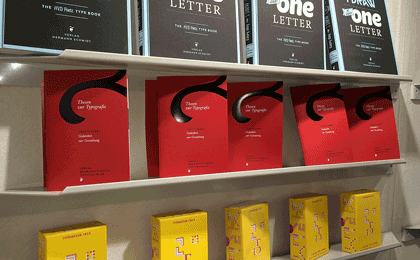
My little book Hanging by a serif caught the eye of Bertram Schmidt-Friderichs, co-owner of Hermann Schmidt Verlag in Mainz, Germany, a fine small publishing company that specializes in books about typography and design. As a result, my book has been translated, revised, and slightly expanded, and is about to be published in Germany. The German title is Thesen zur Typografie (the someone whimsical “Hanging by a serif” proved resistant to translation), and its release coincides with the annual Frankfurt Book Fair, which opens today.

I haven’t held a copy in my hands yet, but I know it has a sewn binding and two-color printing – more ambitious than my original self-published edition. And a few different serifs. Perhaps it will see a more ambitious American edition, too.

Thesen will join other new books in the Hermann Schmidt line at their display at the Book Fair this week.

Display of new Hermann Schmidt Verlag books

TypeCon2014 | Washington DC

Published

This year’s TypeCon, which went by the name “Capitolized” but really seemed to revel in being “Redacted,” was very enjoyable. It was a great reunion of colleagues and old friends, and a fine way to make new friends and meet new colleagues, as this sort of event always is. The hotel, the Hyatt Regency Washington (a few blocks from Union Station and the Capitol), had a nice open bar area in its lobby, with several surprisingly good beers on tap, and proved to be the sort of meeting place that you hope for when you’re organizing something like this.

There were some very good talks (and the occasional dud, of course), including some that I really wanted to hear but that started too early in the morning for me. As I was staying with local friends across town, a few stops away on the Red Line, it was often hard to tear myself away from breakfast and conversation – especially if I’d been up late the night before, doing much the same thing (except for the breakfast part). Theoretically, all the talks were videotaped (except for a couple where the speakers asked not to be recorded), so perhaps eventually we’ll have a chance to catch up on the ones that we missed, for one reason or another.

It was gratifying to see so many talks about non-Latin typefaces; TypeCon is showing an admirable international flavor, despite being the North American type conference. Emblematic of this was the choice of Bulgarian type designer Krista Radoeva as the recipient of this year’s SOTA Catalyst Award.

Even better – and carrying the non-Latin theme further – was the presentation of the SOTA Typography Award to Fiona Ross, who must have done more than any other single person to further excellence in non-Latin type design: most notably in Indian types, but in Arabic, Thai, and other non-Latin scripts as well. The enthusiasm with which everyone greeted the announcement that Fiona was this year’s awardee was palpable. It was a very well-deserved award.

Personal favorites among the talks that I did get to hear included Mark Simonson’s nostalgic paean to the pleasures of phototype, X-acto knives, waxers, and rub-down type; Liron Lavi Turkenich on a failed experiment in updating Hebrew type; Carl Crossgrove’s trawl through the much-neglected range of sans-serif types with contrast and modulated strokes; Thierry Blancpain showing us that, yes, there’s been some Swiss graphic design since the days of Max Bill and Müller-Brockmann; Nick Shinn on the visual marketing of recorded music, 1888–1967; and the very clever way that Victor Gaultney demonstrated to English-speaking readers what it’s like for readers whose scripts are barely and inadequately supported in common electronic communications media.

I can’t help pointing out that this year’s TypeCon featured one of the most unreadable nametag designs I have ever seen. The “redacted” bit was cute, but extending it to the nametags made them utterly nonfunctional. There’s a reason they’re call “name” tags.

Washington, DC, in the summertime is not an ideal climate experience, though we did get one soft, warm evening when it was a pleasure to sit outside at the bar across from the hotel and enjoy the evening breeze. The weather was not as fiercely hot as it could have been, but the humidity was up to its usual standard. I lived in the DC area for a couple of years in the early ’70s, first in northern Virginia and then for a year in the District, near Dupont Circle. (As the Metro train stopped at the Dupont Circle station on my daily commute, I found myself thinking, “When I lived above here, they were just building this station.”) I remember one summer without air-conditioning where I got through it only by pretending that I was underwater the whole time; I simply never expected to be dry, and I was never disappointed. Unfortunately, I can neither think nor work in that kind of climate.

I’ll be seeing some of the same people, as well as many who were missed in DC, next month at the ATypI conference in Barcelona. Must be the typographic season.

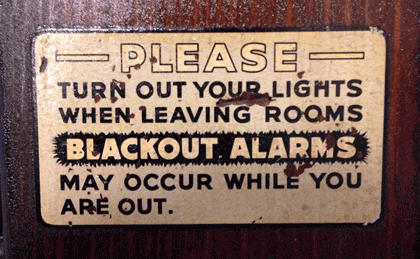
Blackout-alarm sign on the door in an old DC apartment

[Photos: a TypeCon2014 nametag (top); TypeCon attendees suddenly deciding to wear their nametags as headbands (middle); expressive typography in Washington (bottom); and the sign on the door in my friends’ apartment building (above).]

Type to be read

Published

While I was relaxing in one of the comfy chairs in Typekit’s temporary Pop-Up Library, at TYPO SF in San Francisco last spring, I spotted a small booklet that I had never seen, displayed on the shelf. It was one of the series of booklets produced in the 1960s by the Canadian typographer Carl Dair for West Virginia Pulp and Paper (Westvaco), “A Typographic Quest,” each one of which covered a particular aspect of typography. These little booklets are among the best guides to the basics of typography that you can find; Carl was a master of explaining by showing, and his book Design With Type is justifiably renowned for its clarity and usefulness, despite being by now hopelessly outdated in terms of typesetting technology. (The principles don’t change, only the means.)

The book I spotted was A Typographic Quest Number Three, subtitled type to be read; it was the only one of the series that I had never been able to find in my bookstore spelunking. As it talks about exactly what fascinates me in typography – making a page or paragraph of text easy to read – I had kept looking for a copy, but the last time I had checked, the only copy available was fabulously expensive. I resisted the illicit urge to slip Typekit’s copy into my pocket and spirit it off, but I did come away from the conference with a renewed impetus to seek out a copy of my own.

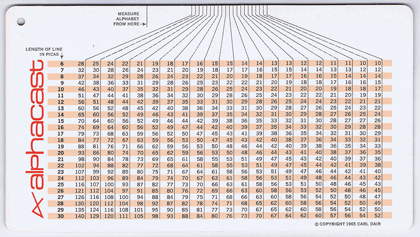
Which, of course, turned out to be available from several sources, and not at ruinous prices; my earlier searches must have been conducted at infelicitous times. At any rate, I now have my own copy of the excellent Number Three in Carl Dair’s series, complete with its own plastic-coated insert, the “Alphacast,” which is a handy tool for “casting off,” or “estimating how much space a typewritten manuscript will occupy when set in any given size and style of type.” Tools like this are pretty much unneeded these days, when we set type digitally and can simply apply the relevant type size and style to the text and see exactly how much space it takes up, but in the days of handset type or hot machine-set metal, there was no easy way to do this.

The Alphacast

In the sort of detail typical of Dair’s work, his Alphacast even deals with the variance created by texts that are full of narrow letters (illicit still) versus those full of wide ones (mammal); the typewritten copy would treat all letters the same, since typewriters typically use fixed-width alphabets, but typeset copy is almost always set in a font with variable widths.

Now the set of A Typographic Quest on my bookshelf will be complete.

A measured response

Published

In on online discussion recently about book design, someone with long experience in print design made the claim that it was a proven fact that unjustified text was harder to read than justified. This was presented as an indisputable conclusion. That got me curious, so I made an effort to get hold of a copy of the source he cited: Colin Wheildon’s Type & Layout: Communicating – Or Just Making Pretty Shapes?. Obviously I would be in sympathy with a book with such a subtitle, but I was skeptical about the claim to hard data.

Wheildon first published this in Australia as a slim booklet in 1984; the version I found was the American edition, revised and expanded, published in 1995 by Strathmoor Press in Berkeley, with a cumbersome new subtitle: How typography and design can get your message across – or get in the way. (There’s a yet newer edition, from the Worsley Press in 2005, which I haven’t seen; happily, it goes back to Wheildon’s original subtitle.)

The heart of the book is the controlled experiments that Wheildon carried out, with as much care as possible and all the expert advice he could get, to test different typographic treatments, and try to find out, scientifically and measurably, which worked better and which didn’t. He came to this question from magazine publishing, with experience in both advertising and editorial design, so his examples are all from the pages, either real or made up for the experiment, of magazines.

Since Wheildon spells out in an appendix exactly how he conducted his research, it’s possible to judge the results. As far as I can tell, his methods for measuring comprehension after reading an article make sense, as far as they go; comprehension of facts may not be the only thing that’s important in reading, but at least it’s measurable.

Basically, he tested comprehension of articles that the participants had read, using a randomized series of questions that would tell him whether they had read all the way through the article or just read the first part and skimmed or skipped the rest. He also mixed this with anecdotal responses to particular features of his sample layouts, which he probably found irresistible but which renders many of his results dangerously subjective.

The real problem, though, is that in too many of his experiments, he didn’t measure comparable alternatives. It doesn’t really tell you much about the difference between serif and sans-serif text typefaces if the serif face you’re testing is Corona, a workhorse newspaper face, and the sans-serif is Helvetica, which was never intended for long text – and you’ve set both examples at exactly the same point size and leading. Testing a sans-serif typeface that was designed for text, and adjusting the size and spacing parameters to make them appropriate and comparable, rather than literally the same, would have been a much better comparison. Similarly, in a section about optimal text sizes, he made no allowance for varying x-heights and the difference in apparent size of different typefaces; he just compared 10pt to 10pt, no matter what the font. Even his test of ragged-right versus justified text tells us nothing about the details of how the text was typeset; it was just the same layout with either justified or unjustified setting.

I showed my borrowed copy of Type & Layout to Kevin Larson at a recent type pub in Seattle. Kevin is Microsoft’s researcher into typographic readability and legibility, so this is right up his alley. Naturally he refused to pass judgment based on just browsing through the book, but he did ask some pertinent questions about the specific test conditions and methods, which I found useful in thinking about Wheildon’s results.

What I found missing in Wheildon’s examples and his tests was the fine points of text typography that I’ve been dealing with for the past thirty-five years. In comparing serif and sans-serif settings of the same text, he used typefaces that, while indeed serif and sans, do not otherwise have much in common. Not surprisingly, the test subjects had a harder time reading a column of 8/9 Helvetica than they did a column of 8/9 Corona.

That’s the most obvious failure, but there are all too many places in Wheildon’s examples where he’s testing gross differences rather than well-adjusted settings in each format. He wrote this in the 1980s, so it’s no surprise that it doesn’t reflect the current state of typesetting technology, but it doesn’t even reflect the state of the technology in the 1980s: I was amazed that in his discussion of letter-spacing he confused kerning with tracking, and he seemed to think that letter-spacing in digital type could only be adjusted using one to four rather large units. (Perhaps he was thinking of the four pre-set tracking values in Aldus PageMaker?) Even at that time, typesetting systems were spacing in tiny fractions of an em.

Nothing in his trials had any way of measuring how much of a reader’s response was inherent and how much was just a matter of what they were already used to. (“We read best what we read most,” as Zuzana Licko famously quipped.)

What I came away with, after reading this book, was disappointment. I appreciated what Wheildon was trying to do; I just wish he had done it better. Some of his data is useful; some of it, unfortunately, is useless, or even misleading.

The focus of Wheildon’s attention was on magazines and advertising, rather than books, though most of what he says about reading text would have some relevance for books too. This 1995 edition of Type & Layout is not itself a very good example of book typography; the publisher and editor, Mal Warwick, makes it clear in a note that he is no typographer, and this is borne out on every page. Too often, Warwick’s re-creations of Wheildon’s examples use a different typeface, usually the light digital version of Goudy Old Style that he’s using as the text face of the book. That makes the examples impossible to judge. (Most of the examples that are reproduced directly from other sources are shown much too small to read, so we have to take the author’s conclusions on faith.) The general text typesetting is perfunctory, not carefully considered and adjusted. It’s a shame that the book itself doesn’t set a better example.

This edition is decked out with a foreword by David Ogilvy, an afterword by Tony Antin, and an introduction by Warwick, all of whom make much more grandiose claims than Wheildon himself does. Where Wheildon offers his conclusions modestly (though not without strong opinions), his promoters put them forward as proof positive of everything they hold dear. I don’t blame Wheildon for that, but it undercuts his book’s effectiveness. And it certainly doesn’t help that the publisher added two chapters of his own, which just show bad examples and make snarky comments about them; those two chapters can safely be ignored.

It’s the subtleties of composition, not just the broad strokes of layout or the size or choice of typeface, that make a page of text easy and inviting to read. Anyone who works professionally with book pages and text composition spends all their time on these fine points; and they don’t do it by rote or rules, but by intuition, experience, and paying attention to the text.

The allure of hard numbers – what software companies love to call “metrics” – is that you can quote them to clients or managers as a justification for your design decisions. But when the metrics rule the design, the tail is wagging the dog.

Rules of thumb can be very handy, but all they are is useful patterns; if you treat them like imperatives from on high – or from a few limited tests that others have inflated into ironclad laws – they’ll trip you up every time.

It would be interesting to see the real subtleties of readability tested, but it’s very hard to do, and it would take a lot of time and effort to come up with anything meaningful.

Structured writing for the web

Published

At the end of June, at the Ampersand conference in Brighton, Gerry Leonidas gave a shout-out to an early version of the prospectus for Scripta (“Typographic Think Tank”) in his talk. I had somehow missed this until Tim Brown mentioned it in an e-mail recently inquiring about Scripta. I can highly recommend Gerry’s talk, and not only because he quotes me (7:07–7:49 in the video). Although he starts out with a disclaimer that “this is a new talk” and he’s not sure how well it will hang together, in fact it’s extremely coherent; Gerry is both articulate and thoughtful about the wide range of questions (and, rarely, answers) involved in typography on the web.

Gerry used my “wish list” from “Unbound Pages” (in The Magazine last March) as a jumping-off point for his own ideas about the structure of documents and the tools that he wants to see available. He wants tools for writers, not just for designers, that will make it easy to create a well-structured digital document, one that will maintain its integrity when it gets moved from one format to another (as always happens today in electronic publishing). Gerry’s own wish list begins at 20:47 in the video, though you won’t want to skip the entertaining steps by which he gets there.

What he proposes is a way to separate the sequence of information from its relative importance and interrelatedness. “This is what I really want: I want someone to go out there and take Markdown, which I use constantly, and take it from something that clearly has been written to deal with streams of stuff with some bits thrown on the side … and allow me to have this extra intelligence in the content – while I’m writing it – that will tell me how important something is, what sequence it has with other things, and will then allow me to ditch quite a lot of this stuff that is happening there.” The “stuff” he wants to ditch is all the hand-crafted formatting and positioning that makes a digital document cumbersome and difficult to translate from one form to another.

The problem is, as Gerry admits, training people to write with structure in mind. (Every editorial designer who has tried to get writers to use paragraph and character styles will break out into a hollow laugh at this point.) What he’s advocating is tools that will make this easy to do, instead of something that only makes sense to experts. I think he was a little disappointed that nobody leapt up at the end of his talk to say, “We’ve already done that!” But perhaps he has planted the seed.

A brace of book launches

Published

I’ve been to two very well attended book launches in Seattle this week – both them within walking distance of my home. The first was for Nicola Griffith’s new novel Hild, at Richard Hugo House on Wednesday; the second, last night, was for Judith Gille’s self-published memoir, The View from Casa Chepitos: A Journey Beyond the Border, at the Elliott Bay Book Company. It was gratifying to see both venues packed.

Nicola’s book I have no connection with other than knowing and admiring Nicola and looking forward to reading each of her novels. Judith’s book I do have a connection with: I designed and typeset the interior. (I had nothing to do with the flamboyant and effective cover, which was designed by Dorit Ely.)

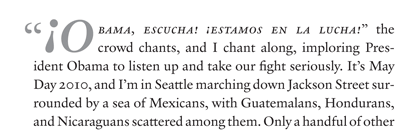
I got to use Mark van Bronkhorst’s recently released OpenType Pro version of MVB Verdigris, which was completely appropriate to the visual feel that Judith wanted for her book. I even got to confront the interesting problem of how to treat a chapter opening with a drop cap, when the first word is the beginning of a quote in Spanish, requiring not only opening quotation marks but an opening inverted exclamation point as well. I could have finessed the problem by de-emphasizing the punctuation marks somehow, but in the end we decided that it worked with some judicious spacing and fiddling around. (Oh, yes: our chapter-opening convention also included small caps for the first several words, which in this case required italic small caps. Happily, Verdigris Pro includes them.)

Chapter opening from 'The View from Casa Chepitos'

I’ve already read and enjoyed Judith’s memoir, a thoughtful and empathic account of becoming a part-time resident of San Miguel de Allende, Mexico. Now I’m enjoying Nicola’s lively historical novel, in which she creates a believable milieu and a strong character for the 6th-century Anglo-Saxon abbess, Hild of Whitby.

One thing that both books have in common is strong women – including the authors.

TypeCon Port L’ampersand

Published

For last month’s TypeCon in Portland, Oregon (“TypeCon Portl&” as it was dubbed), Jules Faye and I prepared a talk about the work of her late partner Chris Stern, who was an innovative letterpress printer with a particular fondness for sans-serif type. Although he came to typography through learning to set phototype at a local job shop, and later headed up the type department at the fledgling Microsoft Press, Chris taught himself letterpress printing and became an expert in hand-set and hot-metal typesetting. At his death, Chris had been working on a manifesto about the use of sans-serif type in metal, with lots of images both informative and playful and lots of samples of carefully set Monotype and foundry sans-serif type. He never completed this work, but Jules unearthed enough notes and proofs and trial settings that we could weave a narrative around them that we thought would inspire some of the printers and typographers in the audience.

We got to show some of Chris’s meticulously layered typographic compositions, as well as fanciful characters – printed faces and bodies made up entirely of metal type. We also showed some of his serious book work (concentrating on the ones where he used sans-serif), as well as some sample spreads for his unfinished manifesto: juxtaposing sober blocks of sample text with whimsical but pointed illustrations. I even scanned and zoomed in on several pages of Chris’s notes and edits to his own proposed text – but a little of that goes a long way when you’re seeing it projected on a big screen. One passage from his own text that we quoted and showed in a sample setting was his description of the type for the manifesto itself: “Sans Transgression/ This book was going to be 100% sans serif. It seemed only fitting, after all. But along the byways of design, Commercial Script jumped into my path and I couldn’t resist. I feel confident that this will be my only sans transgression. My partner, however, says not to worry because there aren’t any serifs, just swirls.”

Among my favorite images are the multi-color prints of U-Man, an anthropomorphic character whose body is a bold, condensed capital U (sans-serif, of course!) and whose other body parts sometimes changed from one incarnation to the next.

In presenting this material, Jules felt that we were opening up Chris’s unfinished manifesto and giving it a continuing life, whatever form that may take. Nothing is ever finished.

Warning! Adults Only! Product contains letterforms at their most exposed! Viewer Discretion Is Advised. Adults Only: Warning!

On Sunday afternoon, I caught a city bus up to the north end of town for an open house at the C.C. Stern Foundry, which is now the home of much of the printing and type-casting equipment that once filled up the barn at the “printing farm” of Stern & Faye. Many TypeCon attendees made the trek, so there was a lively group of printers, typographers, and interested amateurs. And whoever designed the nametags for the volunteer staff of C.C. Stern put to shame the design of the TypeCon nametags, which (typically) gave pride of place to the logo and kept the name too small to read from across a room.

This was a good TypeCon, full of good conversations and with a number of excellent talks and presentations. Of course Portland is a great city to visit – it’s hipster central, a land of coffee, beer, wine, and food trucks, with a very convenient transit system. The weather even gave us a taste of Northwest drizzle, though it also gave us some un-Northwestern warm humidity. I think pretty much everyone had a good time.

The visual identity for this TypeCon rendered the host city as “Portl&” in a very retro-’80s graphic style. I kept referring to it as “Port L’ampersand” – the little settlement on the Willamette River that grew up to be a real city written with real letters.

Next up on the typographic calendar: ATypI in Amsterdam, October 9–13. See you there?