


From early in the association’s existence, the hope had been that ATypI could be a forum where business disputes over typeface designs and rights might be worked out, rather than taken to court. There was a disparity globally about the protection of typefaces; some European countries recognized typeface designs as copyrightable works, but the United States did not. The reasoning for this under US law is that the design of a “useful article” can not be copyrighted, and an alphabet was considered a useful article. However egregious this may seem to people who understand typeface design, this is still the case in the United States, which was also unsuccessful in establishing industrial design protections (an in-between form of design protection prevalent in other countries) – and therefore typeface designs are not protected even today in the United States.
ATypI had created a mechanism for opponents to seek arbitration over typeface design rights under the aegis of ATypI. Indeed, the association set up an internal arbitration board, as required in the Code Moral, originally chaired by Gerrit Willem Ovink – but, according to long-time Board member Wolfgang Hartmann, “His mediation was only called upon once.”
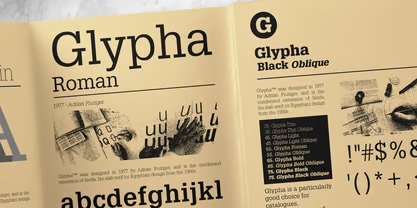
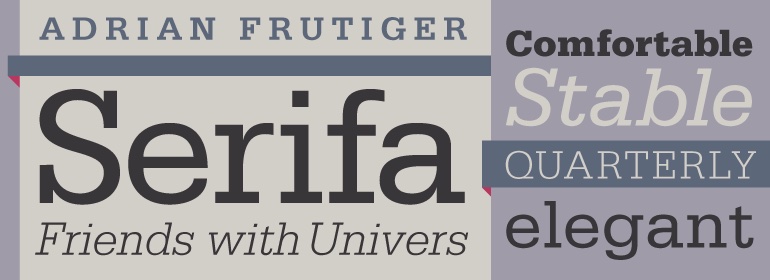
It was in a dispute over whether Stempel’s slab-serif typeface Glypha should be considered a copy of Serifa, which Adrian Frutiger had designed for the Bauer foundry. Hartmann’s Barcelona-based Fundición Tipográfica Neufville held the rights to Bauer’s type designs.
Ovink presided over the proceedings in Amsterdam, Gerard Unger was appointed as an assessor for Stempel, and my friend Eckehart Schumacher-Gebler participated on my side. The verdict was: Glypha is a copy of Serifa. I agreed to a licensing agreement with Stempel and later with Linotype, thus restoring our friendly relations.
This was an example of what Hartmann describes as the general attitude within ATypI at the time: “The relationship was collegial, and lawsuits for copyright infringement were to be avoided.”
This collegial approach did not survive the shift to digital type and the dominance of American companies in the type business. This was exemplified by the continued denial in the 1980s and early 1990s of licenses for type designs to American hardware manufacturers. Later this thawed as the digital revolution superseded the importance of a captive and exclusive type library – particularly in light of PostScript-driven, device-independent font technology. Licensing then loosened up so type rights owners could at least realize some revenue from licensing to other foundries while not having to produce their own designs in Adobe PostScript-compatible formats (a very expensive and labor-intensive technical process at the time.)
In 1998, at the conference in Lyon, there emerged an ongoing dispute between a number of type designers and an American company that had acquired the rights to one of the major European digital type libraries. The question was whether the designers were owed royalties on fonts sold after the acquisition. This seemed like a natural topic to be brought up at the conference, and the designers asked for time on the program to discuss it. The owner of the American company, however, threatened to sue ATypI if it permitted any public discussion – what exactly they would have sued over was not clear, but likely either torts (unlawful interference) or reputational damage (libel and/or slander). The Board of Directors, realizing that this put the association in an untenable position, decided not to include this program item on the subject. (Not surprisingly, this all became a topic of intense unofficial conversation throughout the conference.)
If it hadn’t been evident before, this incident made it very clear that, legally, ATypI had only the ability to create conditions for cooperation between designers and licensors, as suggested by the Code Moral. It could encourage high-minded business practices, and indeed the association tried to do that, but it was not the responsibly of the association to enforce cooperation; as this was and is the purview of international treaties, national laws, and civil courts. This was much resented by some of the members, who wanted ATypI to be an enforcer, but it was the reality. And indeed, no corporate or individual members were prepared to fund the association at the level that would have been required for ATypI to actually legally intercede.
Several years later, in 2003, a lawsuit for defamation was filed against the association. The plaintiff’s claim was that ATypI had defamed them and their home-based business by their identification in the ATypI discussion group as a seller of pirated fonts (the member’s online conversation had recently been published online as an altruistic effort to share the expertise of the members with a broader public) . The plaintiffs sued for an astounding 18 million dollars, aimed not only at the association but at a number of designers who had expressed opinions in the published discussion.
The arrival of the lawsuit, and the discovery that the association was not legally incorporated in any country in the world, and worse, did not have director’s insurance, caused several officials to submit their resignation, among them Linotype’s board member Bruno Steinert and the current executive director Sharon Moncur. Ironically, resigning after the lawsuit was filed did not relieve anyone who was an officer or lead employee of responsibility or liability. Cynthia Batty was a member of the Board at the time (and therefore personally liable along with her husband Mark Batty, who was the President), and she volunteered to take over as Executive Director in order to ensure that the lawsuit would be professionally managed on the association’s end. Before his departure, Bruno Steinert had introduced the association to a law firm in New York who became the defense counsel for the association and was managed by Cynthia and Mark.
As noted above, several member designers were named in the suit, as well as the association’s webmaster. They all agreed to allow the association to manage the defense of the entire suit, which helped to reduce individual people’s liability to hire their own lawyers (many were not in the United States) and therefore to not have to individually pay legal bills. The final cost to the association of this effort was borne by some key sponsors, and the bulk paid with the proceeds of the Vancouver 2003 conference, which Cynthia, as the Executive Director, managed so as to produce as much revenue as possible to cover legal costs. In the end, the association did not have to incur debt to defend itself and its members.
Both Cynthia and Mark put an enormous amount of behind-the-scenes effort into managing ATypI’s response to the lawsuit. The case was hampered by the problem that screen shots of internet pages were at that time not admissible as evidence, and along the way the plaintiff conveniently disposed of their hardware so it was not available for discovery. After depositions it became clear that there was not a deep-pockets director’s insurance policy for the plaintiff and their counsel to milk. This, together with mounting evidence that the case was flimsy, caused the Board agreed to settle with the plaintiff, on the advice of Bob Givens of Agfa. This was, in the end, the best course of action; ATypI and the designers, webmaster, executive director ,and board members were thereby relieved of the risk of a court case which would have cost hundreds of thousands of dollars and which had a risk of a potential unknown outcome. In the early days of the legal action, this lawsuit was a matter of public record; the final settlement resolution, however, was agreed to remain confidential, which is typical in such cases.
During the course of the lawsuit, Cynthia arranged for ATypI to be incorporated in the United States as a 501(c)(3) nonprofit corporation and the Board agreed to acquiring directors’ insurance going forward, to protect the officers and employees of the association.
“Sadly,” says Cynthia in retrospect, “the altruistic idea to publish the group’s conversation to the world for their edification and benefit was scrapped immediately. That conversation was filled with wonderful discussions; I hope that someone will mine it at some point for some articles or a book – minus any components that might precipitate a lawsuit of course.”