


After Type90, ATypI’s reach was wider and more public than ever before. It was still, at heart, an industry association where people from each of the large type companies could come together to schmooze and do business, with a changing roster of sponsors and corporate backers to underwrite the costs of each year’s conference. (As Cynthia Batty it, “It was a supper club for rich employees of manufacturers. And as such, what a joy to go to them! They were fabulous.”) But at the same time, the conferences were attracting people with a professional interest in type who didn’t necessarily work for one of the major companies. As the design of new typefaces became a more dispersed endeavor, with individuals or small teams capable of creating their own independent digital font foundries, and with resellers such as FontShop marketing and selling those fonts directly to graphic designers, each successive ATypI conference became a more eclectic mix of big players and small enterprises.
Font Wars, OpenType, Unicode
What became known as the “Font Wars” was a struggle for dominance in the type business between two technical models and two business models: PostScript Type 1 fonts and TrueType fonts. This was naturally reflected in discussions, lectures, conversations, and arguments at the ATypI conferences of the period.
Simply put, PostScript fonts were generally preferred by graphic designers working in professional publishing and advertising, while TrueType fonts were far more popular in the office environment, where Microsoft’s Windows platform was dominant.
The ultimate solution was agreement on a new technical standard for fonts, called OpenType, which could incorporate both Type 1 and TrueType font data and in addition – significantly – allowed for much larger font files and was based on the worldwide Unicode standard. The flexibility of OpenType’s layout features meant that, for example, a font might easily contain the full character set for the Latin alphabet, including all the refinements like true small caps, ligatures, and old-style figures that had been relegated to supplementary PostScript fonts, which a user had to acquire and know how to use. The full adoption of OpenType took several years, as technological advances usually do.
OpenType, as its name implies, also opened up the possibilities for the world’s many scripts that require much larger character sets.
Parma 1991
The 1991 Parma conference, in the heart of Bodoni country as well as Italian culture and cuisine, was sponsored by Agfa and organized by Cynthia Batty along with Agfa’s public-relations representative in Italy, who handled much of the hands-on work. Long-time President Martin Fehle, who at 17 years in office was ATypI’s longest-serving President, turned over leadership to Ernst-Erich Marhencke, a Board member of Linotype-Hell. There had been some pushback after Marhencke’s election, because he was not well known to the membership at large. The minutes of the Parma Board meetings report: “In the course of the discussion it became evident that some of the ATypI members would favour a President who is younger, preferably Non-European and independent of Linotype.” They also worried that Marhencke didn’t have a high enough profile among the members. In response, the new President made plans to participate in meetings of the three major committees (manufacturers, designers, educators) as a way of introducing himself to them.
It was also at this time that the Board began giving thought to an updating and reworking of the association’s statutes. To this end, they established a task force to revise the statutes “and present to the members what a modernized ATypI should look like.”
Goody bags
From at least Type90 onward, attendees at ATypI conferences were given “goody bags” when they registered. These were usually shoulder bags containing a variety of items contributed by members or businesses represented at the conference. There were sometimes debates about what should or should not be included in the bags (should only members be able to contribute? sponsors? local businesses?), but in general they contained new catalogs or type specimens from prominent type foundries, magazines or booklets about type, flyers or advertisements for upcoming typographic publications, and sometimes more frivolous items such as letterpress postcards, buttons, or stickers.
LetterLetter
Gerrit Noordzij’s idiosyncratic and sporadic publication LetterLetter, which he began publishing in 1985 after taking on the chairmanship of ATypI’s Education committee, took on a more official rôle within ATypI in the 1990s. The issues, originally hand-written, later typeset in typefaces of Noordzij’s own design, were distributed to members of ATypI.
In the first issue, he had described LetterLetter as “necessarily informal and intentionally provocative.” The content focused on all aspects of writing, particularly in Noordzij’s analysis of how letters were written and constructed. Never limiting himself to the pragmatic, he would often make connections between these hands-on activities and the cultural history of European civilization.
The Board also explored possible collaboration with STD (Society of Typographic Designers) for co-publication of Typo News along with support for LetterLetter.
26 Letters
A project that had begun at the end of the 1980s saw its second iteration in the early ’90s: an ambitiously produced wall calendar called 26 Letters,” featuring monthly pages from different designers about the history and aesthetics of type. It was the brainchild of Eckehart SchumacherGebler, who had rescued the Offizin Haag-Drugulin in Leipzig from being sold to a mail-order company after German reunification and then became a scrupulous caretaker of the typographic legacy of the DDR.
Although it was intended as an annual publication, only two editions of 26 Letters were published, in 1989 and 1992. Both were sumptuously designed and printed, ring-bound, with fold-out pages displaying each typeface along with a calendar grid with the dates printed in that month’s typeface. The first edition included an index, a glossary, two prefaces, a table of contents, a one-page colophon, and a list of the addresses of the type companies represented in the calendar’s pages. The second edition was more modest, with only the actual calendar pages and historical essays, no front or back matter.
SchumacherGebler was the editor, coordinating with Colin Banks in London, with design by Hans Dieter Reichert of Banks and Miles studio, and historical text provided by John Lane. (The text was translated into German and French for this trilingual publication.) Production was backed by the Bundesverband Druck, the German printers’ association, and by ATypI.
In a preface to the 1989 edition, ATypI president Martin Fehle said of the calendar: “Its aims are those of ATypI: to spread information about the means of communication and scientific transfer of the thoughts, facts and ideas which have determined our civilization.”
Budapest 1992
The 1992 conference in Budapest was relatively small, partly because of conflicting scheduling of other events and partly because it was in a country that had until recently been behind the Iron Curtain. Only about 100 people attended the AGM, but the Working Seminar held immediately afterward had 50 attendees.
Roger Black recalls that the influx of Dutch type designers had a significant influence at the Budapest conference, and describes the program, although “modestly organized,” as intellectually stimulating.
Responding to changes in the world of typography and the type business, Yvonne Schwemer-Scheddin had put forward a document that she titled “The Identity Crisis of ATypI,” and asked for it to be considered at the AGM. She made the point that in a multi-media world, typography was no longer limited to the printed page, yet the remained the narrow focus of ATypI. Ernst-Erich Mahrhencke responded:
As president of the organization I fully support Yvonne’s ideas to start for new horizons and not to stick to our traditional visions which, more and more, are being paralysed by fast technological developments.
The Board’s subsequent report to the members said: “Along with a number of philosophical reflections, it shows that ATypI must redefine and reorganize its objectives in order to take over urgent multimedia tasks to help shape a more humane world.” The Board then created a strategy team to address the issues that Schwemer-Scheddin had raised.
Antwerp 1993 & TypeLab
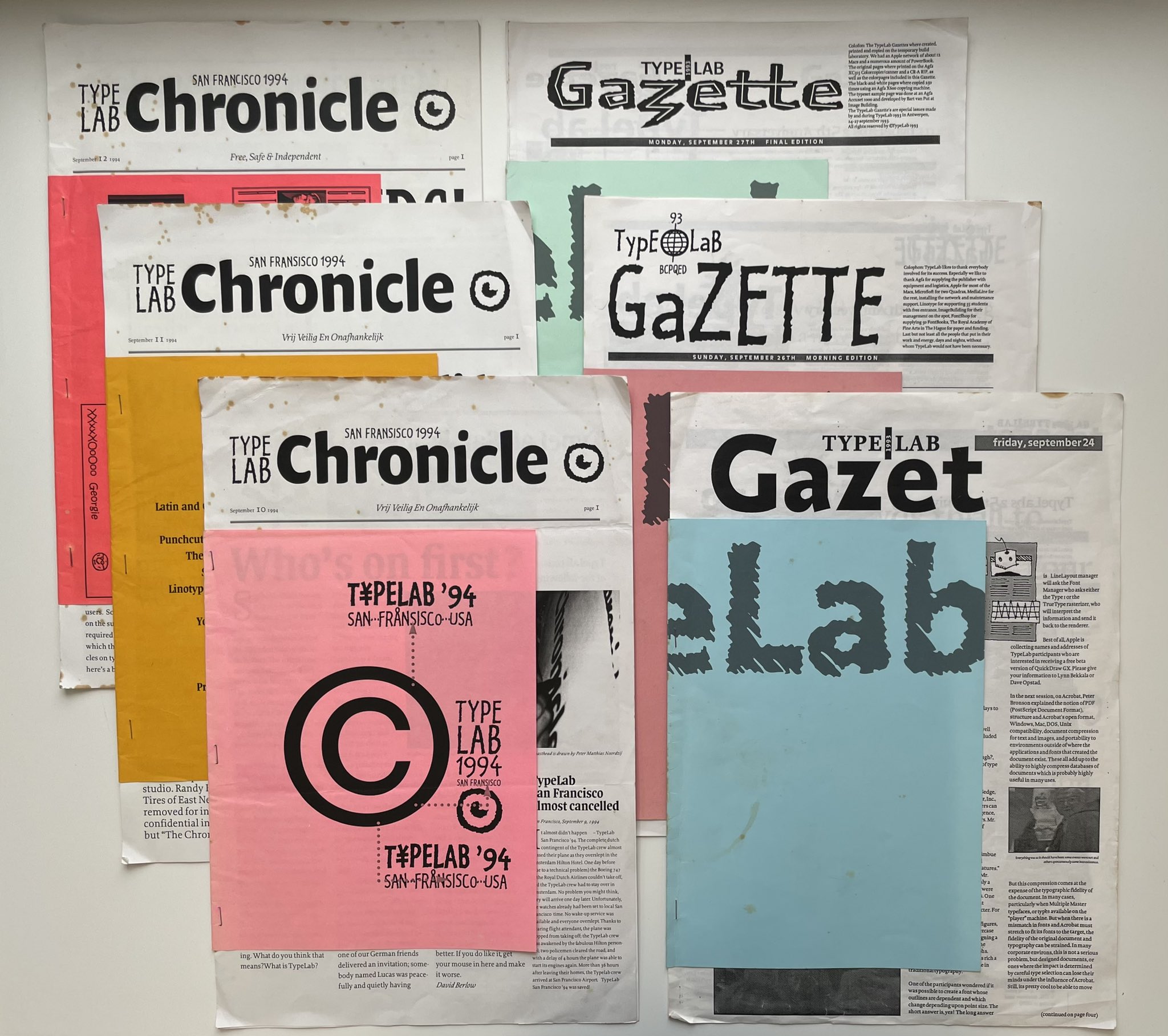
The 1993 conference in Antwerp saw the advent of the subversive TypeLab, which Petr van Blokland described as “a rogue version of ATypI” that he put together along with a few collaborators (among them Gerrit Noordzij, David Berlow, Erik van Blokland, and other ATypI designers). It grew out of their experience in Budapest a year earlier, when the various international delegates who didn’t speak Hungarian found themselves milling around outside during a lecture on Hungarian type that was being delivered in Hungarian (naturally) without translation (unfortunately). It became apparent, Petr says, that there might be value in providing something else for people to do when they didn’t want to spend all their time in the official program.
After Budapest, Petr suggested to the ATypI Board of Directors that they plan some kind of informal alternative for the Antwerp conference, but the Board wasn’t willing to do that. So Petr and his friends set up their own alternative, and dubbed it TypeLab.
This was a time when digital typography was still thought of as new; very little content about digital type had made its way into ATypI’s main program so far, and what had been included was largely theoretical. TypeLab was meant to be a sort of hands-on side-conference, an experimental laboratory, with a room full of equipment where anybody could try out the new technologies.
They managed to secure sponsorship from Agfa, which made it possible to have the computers, software, and printers all freely available.
“The room of 15 x 15 meters,” says Petr, “was divided into four quarters: a little lecture theatre of 40 chairs, a design studio with Macs and software, a ‘lounge’ where people could sit, talk, and show their sketches and drawings (note that there wasn’t anything like phones or laptops back then), and a printing department (loaded with printers, a typesetter, and copying machines). The board of ATypI didn’t go for the idea, so we planned to rent a space on the other side of the street.”
In the summer of 1993, Agfa, the main sponsor of the Antwerp conference, got wind of the idea, so Petr got invited to the Antwerp headquarters in late July. The appointment was made with the chairman of the board of Agfa. “Also present was the then chairman of ATypI, who still didn’t want TypeLab to happen. But Agfa left ATypI no choice and promised the intended lunch space to TypeLab, also allowing a wish list for equipment.”
Over the course of the conference, they made their own magazine for the delegates, conceived and printed on the fly, using fonts that had been created right there just the day before. “The A3 printed newspapers, ready at breakfast for the attendees, were indeed made with the type that was created the day before. Many traditional/regular ATypI participants thought that to be impossible. Making type was something costing years, not days.”
Petr recalls a student at the Antwerp conference describing to him that when Adrian Frutiger had wandered into the lab, the student had demonstrated to him how Fontographer worked – a technology that Frutiger was completely unfamiliar with at the time.
TypeLabs were organized at ATypI conferences for the next several years, until eventually this sort of hands-on technical experience got incorporated into the regular program.
San Francisco 1994
In 1994 ATypI returned to the United States, timing its conference in San Francisco to coincide with that year’s Seybold Conference.
The explosion in high-quality digital typefaces was partly sparked by the Adobe Originals program of type development, which wedded historical knowledge and sensibilities with advanced technology expertise. At the conference, which ran two parallel tracks of programming, Adobe designer Robert Slimbach’s talk about designing for the Multiple Master format drew a standing-room-only crowd in a smallish meeting room, leaving the talk scheduled opposite his to be sparsely attended. Digital fonts with advanced typographic features were the order of the day.
There was debate about the respective benefits of Adobe’s Multiple Master font format and Apple’s TrueType GX, both of which offered ways to create fonts that could have flexible design parameters, such as a variable width axis, incorporated directly into the font. (In the end, the Multiple Master format failed to achieve full acceptance except in the high-end graphic design community, at least in part because Adobe never built support for the format into anything but high-end applications. TrueType GX also disappeared, but many years later it would form the foundation for what became variable fonts.)
There was also debate about how ATypI and the type industry in general should adapt to the new technologies. The popularity of desktop publishing and the ease with which designers could create their own fonts, free of the restraints of the old typesetting machine industry, had led to a drastic drop in the prices of digital fonts. This was having an impact not only on the old-school type companies but on the new one- or two-person digital type foundries, too.
“If I were going to write about this conference,” said Chuck Byrne, a contributing editor of Print magazine, during an informal round-table in TypeLab, “I’d say there’s the Type Police over there in those two rooms, down here in this room is the Typo Gang, and every once in a while there’s a drive-by shooting.”
For his talk on Multiple Master fonts, Robert Slimbach gave a preview showing of Adobe Jenson, his revival of the classic types of Nicolas Jenson, considered by many to be the most beautiful and functional roman type ever made. He gave attendees a handsome designed booklet about the development of Adobe Jenson, created by Slimbach and Fred Brady, Adobe’s manager of new typographic development.
Alastair Johnston, a British typographer long established in the San Francisco Bay Area, went around the conference interviewing people and asking the provocative question, “Do you have to be a nasty person to be a good type designer?” He got quite a variety of answers. Zuzana Licko said, “I don’t know: I’m not a nice person. You have to be reclusive to be a type designer.” Matthew Carter replied, “Probably not, but it might help. Why?”
Gerard Unger, who had just delivered a talk about William Addison Dwiggins, told Johnston:
What I found was my main fascination with Dwiggins is there are so damn few type designers with a sense of humour. Maybe that’s what makes them nasty. But I find since the introduction of the Mac, the humour percentage among type designers has gone up considerably. Probably it was the production process that took the fun out of them and out of their work, and that may be turned around. Since that is gone they are nicer people. And they won’t do nasty things to their daughters and their dogs any more, I think. I must admit I do not have a dog so I can’t say.
The 1994 Prix Charles Peignot was awarded to Carol Twombly, who along with Slimbach (who had won it three years before) was Adobe’s principal designer. This was a recognition of the central place of Adobe’s type-design program in those years.
During the conference, as a response to the traditionally male-dominated type business, three young women designers (Susanne Dechant, Andrea Fuches, and Elizabeth Cory Holzman) decided to found a subversive initiative that they called Blondes Prefer Type.
FontShop hosted a party at Guaymas, a high-end Mexican waterfront restaurant in Tiburon, directly across the Golden Gate from San Francisco. Most of the guests took a convivial ferry ride across the Bay, and never had to set foot on land – the restaurant was literally on a pier.
Barcelona 1995
The 1995 conference in Barcelona was organized by Wolfgang Hartmann, principal of Fundición Tipográfica Neufville, with support from Daniel Giralt-Miracle. Special events including an exhibition of works by Spanish graphic artists were overseen by Jesús del Hoyo of the Universidad Barcelona. The conference took place at the Universidad de Biologia, a modern building in a new district of the city.
“The topic of our congress,” wrote Hartmann, “was the Internet, a technology that was still largely unknown at the time. The program of lectures was prepared by Yvonne Schwemer-Scheddin, a journalist and typographer from Gauting near Munich. For the design of the printed program, she recommended Javier Mariscal, who had designed the logo and program for the Barcelona Olympic Games three years earlier.”
The program went smoothly, with one exception: on Sunday a professor from Stanford University was giving a talk about the Internet, during which he was supposed to establish an online connection with the university in the United States. But the connection failed repeatedly, and he had to cut his talk short. The explanation, Hartmann reported, was that Stanford had shut down its internet connection over the weekend. ”The person responsible was woken up, and the lecture could not be continued until hours later. Back then, in September 1995, only the university had an internet connection!”
That conference also saw the election of Mark Batty as ATypI President, with Wolfgang Hartmann as Vice President.
The Hague 1996
The 1996 conference was hosted by the Royal Academy of Art (KABK) in The Hague, and a large proportion of the 700 people in attendance were students. The program, however, suffered from haphazard organization, slipping schedules, and technical glitches. Michael Harvey, in his write-up of the event, called it “a rather unsatisfactory, hit-and-miss conference.”
Yvonne Schwemer-Scheddin, writing in retrospect about the conference, felt that the best part of the event was TypeLab. “Now that it has a few years of experience, and being on home ground, TypeLab was ready to expand its random circus and presented a mixture of experimental topics and current burning issues.”
Michael Harvey, also noting that The Hague was TypeLab’s “home ground,” wrote, “TypeLab had a formidable presence and a lecture program rivaling that of ATypI itself.”
Schwemer-Scheddin also pointed to another forward-looking development:
Another highlight was the opening of the first part of a series on Dutch modernist typography, photography, and design, timed to coincide with ATypI. This exhibition is the first – and rather belated – attempt to officially document the typographical avant-garde movement as it manifested itself in The Hague.
She also noted the slow shift in the type community away from being an all-male fraternity:
In 1994 at ATypI San Francisco an informal gathering of young female designers – Susanne Dechant, Andrea Fuches, Elizabeth Cory Holzman – led to the founding of Blondes Prefer Type. In The Hague they set up a think tank in TypeLab and got a lot of response; even males were curious.
Type journal
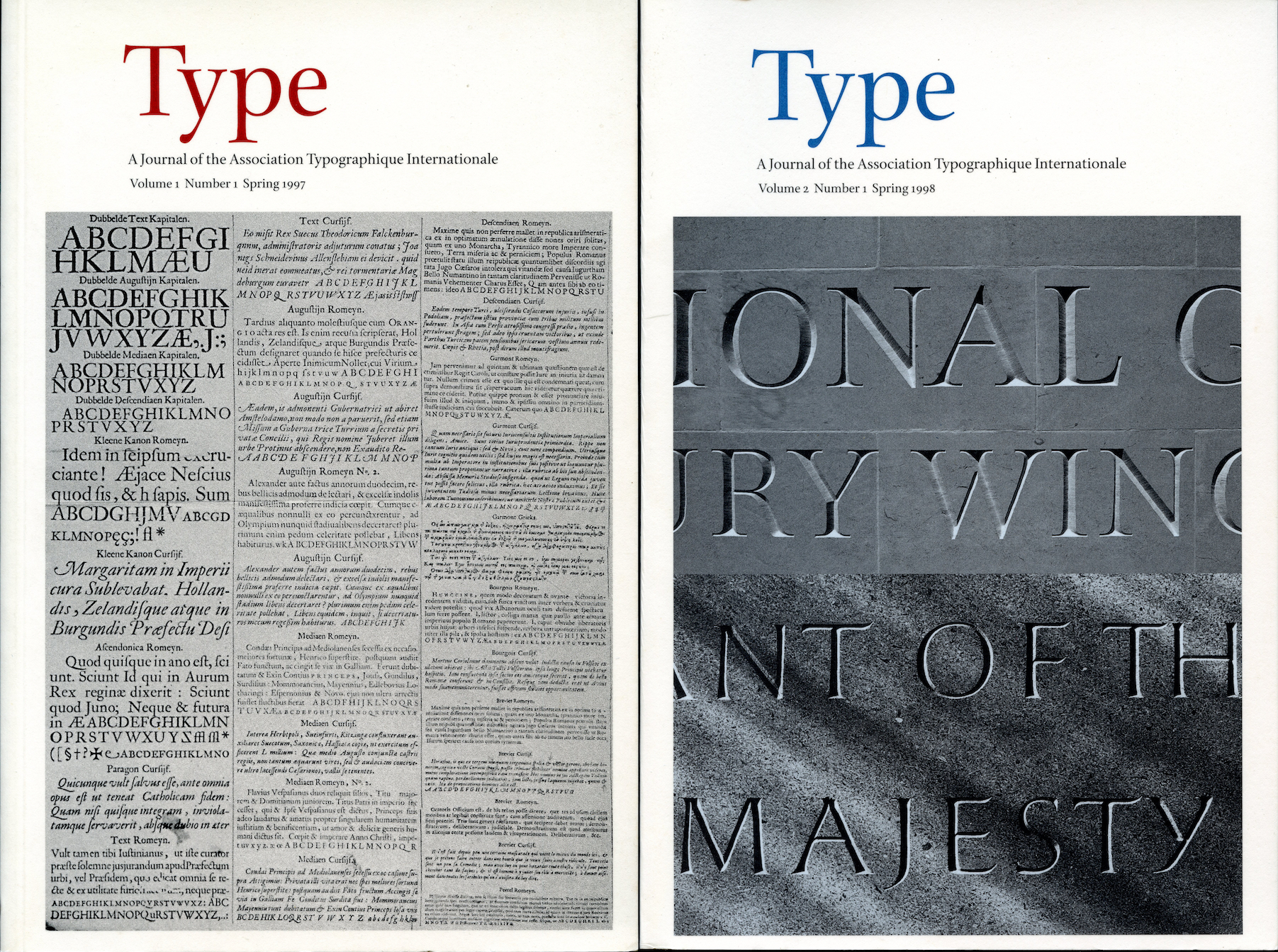
In the spring of 1997, ATypI published the first issue of what was intended to be a semiannual journal called simply Type. The first issue, edited by Sumner Stone, featured six essays, two of which grew out of lectures from the 1996 Hague conference: Max Caflisch’s “Christoffel van Dijck, An outstanding punch-cutter” and attorney Frank Martinez’ “U.S. Design Patent for typeface design.” These two essays neatly reflected the ATypI’s historical roots and its contemporary practical focus.
The other four essays were similarly eclectic: “The quality display of text on computer screens,” by Dr. Peter Karow; “An overview of OpenType,” by David Lemon; “In memoriam: György Haiman,” by Péter Virágvölgyi; and Maxim Zhukov’s celebration of the liberation of Russian type design from the strictures of Soviet control, written in the form of a letter to his friend Vladimir Yefimov, senior designer at ParaGraf foundry, “Towards an open layout: A letter to Volodya Yefimov.”
Only one more issue was actually published, in 1998, also edited by Sumner Stone. Jean François Porchez gathered material for a third issue, but it never appeared; some of the material ended up in the book Language culture type.
Reading 1997
After the 1996 conference in The Hague, epicenter of innovative Dutch type design, the 1997 conference was held in the United Kingdom, at the University of Reading, which had one of the most extensive academic programs of type design and typography in the world.
The venue was austere, housed in university buildings that clustered in two discreet areas, with a long walk through the grass and the woods to get from one to the other. The program, organized by Michael Twyman, took full advantage of the accumulated typographic talent in Reading and the resources of the Department of Typography & Graphic Communication.
Not surprisingly, given the academic location, a major focus of the program was on typographic education. There was also a track called the Fringe, which fulfilled some of the functions that had been previously done at TypeLab. This was part of the process of folding the hands-on TypeLab approach into the main conference at last.
I ran a panel on the subject of “publishing books on type,” there having been quite a few books about type coming out at the time. Originally, Andrew Boag, who was planning the program, had asked Margaret Richardson to run it, but when she learned that I was going to the conference, she cheerfully turned it over to me and turned her attentions to a panel on “marketing type.”
The annual gala dinner was held at Reading Town Hall.
One of the more extravagant give-aways at the conference was a “limited edition newspaper boxed set” from Carlos Segura’s Chicago-based type foundry T26. In the box was a 96-page newspaper featuring the foundry’s new typefaces, which expressed the new digital aesthetic in their designs, along with a CD and assorted items like stickers, napkins, posters, and postcards. Attendees then had to figure out how to carry this large, flat box home with them.
The pragmatic running of the conference was organized by Sharon Irving (now Sharon Moncur), an experienced conference organizer who had managed several Monotype conferences and was asked by Dave Farey, Andrew Boag, and President Mark Batty to handle the Reading conference. It was after this conference that Mark asked Sharon to take on the job of setting up an ATypI Secretariat to run subsequent conferences and manage the practical running of the association. She did this for six years, and her reliable team of support staff, colloquially known as “Sharon’s ladies,” were a familiar sight at every conference.
As Sharon later observed, “This was a period of massive change in the type, design, and communications world as traditional foundries moved inexorably towards the digital and so many small and independent digital foundries were established.”
Lyon 1998
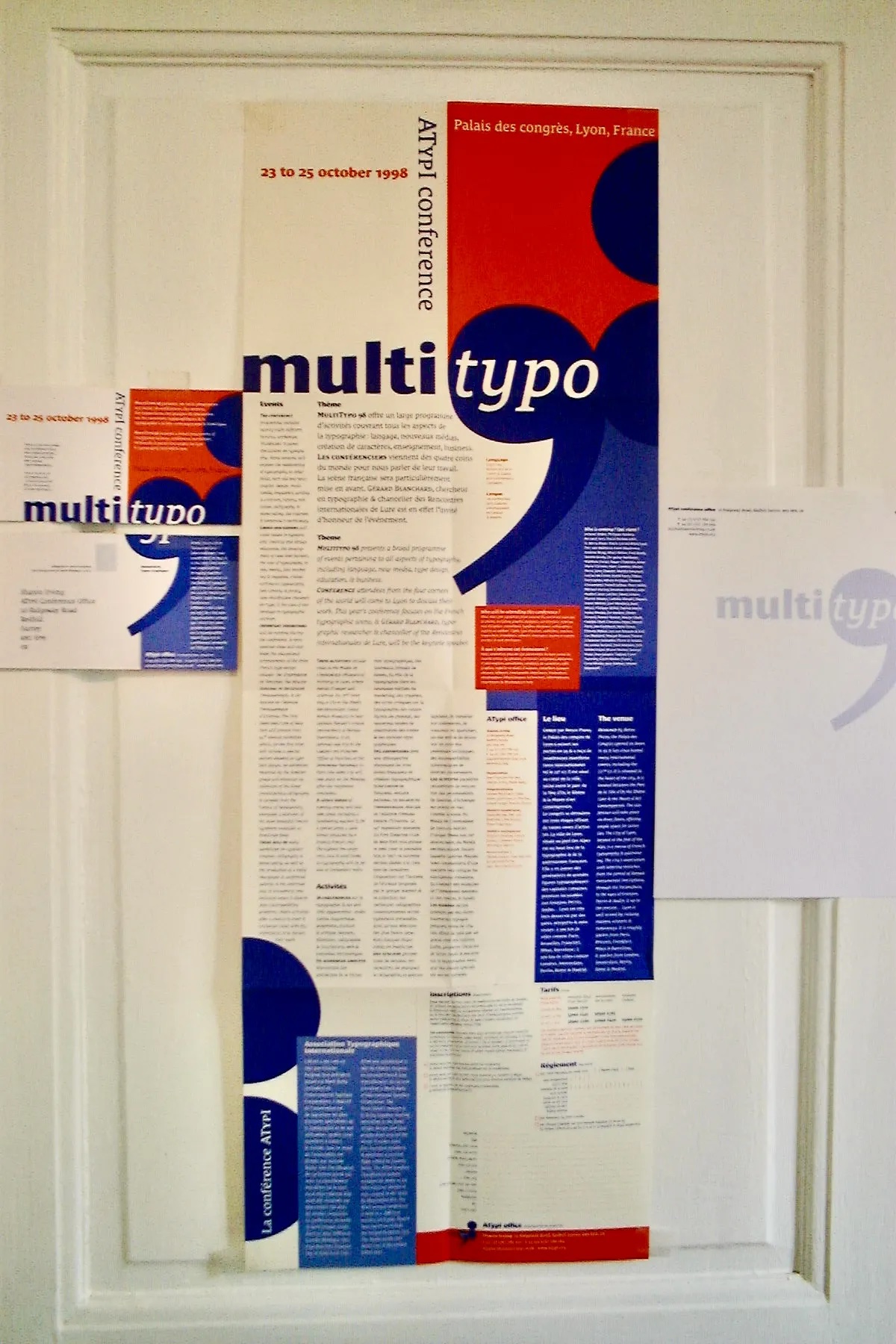
In 1998, ATypI returned to its spiritual home in France, with a celebration of the history and current state of French typography. A pre-conference tour of the Museum of Roman Civilization (now known as Lugdunum, the Latin name for Lyon), was led by Ladislas Mandel, including a magnificent mosaic and the Coligny calendar, a fragmentary bronze plaque with one of the few written examples of the Gaulish language.
The conference proper was held in the Palais des Congrès, a modern conference center designed by Renzo Piano and located in the heart of the city. By contrast, the opening lunch was held in the courtyard of the Musée de l’Imprimerie, which is housed in the 15th-century Hôtel de la Couronne.
The keynote speaker was originally going to be noted French typographer, designer, and scholar Gérard Blanchard, who had been closely involved in planning the program of the conference, but unfortunately Blanchard died suddenly just two months before the conference. A celebratory book about Blanchard was put together in record time in order to be distributed to the attendees, along with the previously planned Lettres françaises, a compendium of current type design in France.
The theme of the conference was “MultiTypo,” and various aspects were named along the same lines: LaboTypo, GazetteTypo, WebTypo, CharitéTypo, QuizTypo. A fundraising auction of typographic treasures and a typography quiz were standard elements of an ATypI conference at this time, and digital workshops with available computers (never quite enough of them) had become a standard part of the program.
Highlights of the program included an interview with Adrian Frutiger conducted by Yvonne Schwemer-Scheddin (unfortunately in English, a language in which Frutiger was not at home) and the presentation by Rich Roat of House Industries. (Roat’s rapid-fire, scattershot American English may have given the simultaneous translators a bit of trouble.)
The conference organizer, Jean François Porchez, was taken by surprise at the AGM when he was presented with the 1998 Prix Charles Peignot.
Boston 1999
The final conference of the 1990s was held again in the United States, this time in Boston, home of Matthew Carter, David Berlow, and Font Bureau, who organized it.
The venue this time was a conference center well outside the city center, which had the perverse advantage of tending to keep the attendees close by and thus interacting with each other constantly, rather than going off to nearby restaurants or bars during the day and the evening. Some people referred to this as the “Red Line conference,” as the Red Line of Boston’s transit system (the “T”) provided a direct connection from the conference venue to downtown Boston and Cambridge.
The keynote speaker was Edward Tufte, well known for his seminal 1983 book The Visual Display of Quantitative Information and subsequent books on related subjects. He gave a lively talk, well illustrated like his books, but it didn’t present much that was new to those who had read them. Luc Devroye, reporting later on the conference, thought it was wonderful; I remember thinking that it seemed like a lecture to one of his classes, not really tailored to the ATypI audience.
Gerard Unger celebrated the work of William Addison Dwiggins, whose career as a book designer, type designer, and puppeteer was conducted from his home in Hingham, just south of Boston. The Boston Public Library had not only a display of Dwiggins’s work but a reconstruction of his studio.
Ed Benguiat gave a funny and wide-ranging talk, full of anecdotes, called “In his own words.”
Roger Black in his talk was a strong advocate for the embedding of fonts in websites, despite the worries of web designers about the size and speed of downloads.
This was also where Adobe announced that its Multiple Master font format would no longer be developed or supported, while promising that the Adobe font library would be converted to OpenType format. New OpenType versions of their existing families would incorporate some of the variations, such as width, weight, and optical size, that had been an important part of the flexible Multiple Master format.
One of the exhibits on display during the conference was the results of the Kyrillitsa 99 competition for Cyrillic type design, which showed off the skills of a new generation of Russian type designers.
Luc Devroye, who had been critical of some of the program choices on the second day, admitted in his report: “The specter of poorly scheduled parallel events was expertly avoided by careful planning, often pitting a technical session against an artsy presentation. As a result, the pace of the conference and the flow were smooth and consistent.”
Characters
At the San Francisco conference, type journalist Yvonne Schemer-Scheddin told Alastair Johnston, “So you see why this conference works, although anything goes and it’s thrown together and in a way backwards because of this calligraphy stuff and letterpress and so forth. It’s because the people are so lively. The people are creative and active and lively. This is why it still works.”
Roger Black, looking back later at that era, claims that one of the major attractions of the type community is the eccentric characters that it attracts. He recalls spotting Robert Norton lying on top of a railing in Basel, smoking a pipe that somehow never dropped ash onto his face, and Charles Peignot wearing a lightweight glen plaid suit and escorting a pair of beautiful French women. In Barcelona, he says, he watched American type designers Jim Parkinson and Ed Benguiat scuffling on the ground in the dirt, because Parkinson had shown a slide of a redrawn masthead for the New York Times Magazine that Benguiat thought was an attempt to claim credit for his own prior work. People in the crowd around them were saying that someone should break them up, but Roger responded, “No, don’t! This is fantastic!”
As Roger observed, one of the main reasons that people attended ATypI conferences was for its social side. With or without dirt wrestling.