


The 1980s saw the desktop revolution transform digital publishing – a technological revolution that had enormous effects on both the business of type and the practice of typography.
Just before the introduction of PageMaker and the LaserWriter in 1985, which kicked off this revolution, ATypI held its fifth Working Seminar, at Stanford University in 1983, focusing on the coming challenges of digital type. The stated theme was “The Computer and the Hand in Type Design.” The event was organized by Chuck Bigelow, who at the time held the unique title of Professor of Digital Typography at Stanford.
Bigelow had just been awarded a MacArthur fellowship, the first graphic designer to receive one. His position at Stanford was an unusual joint professorship, split between two different departments: Art and Computer Science. He and mathematics professor Donald Knuth had organized the university’s graduate program in digital typography (a short-lived but very influential program), and as an outgrowth of this they put on the ATypI Working Seminar: a ground-breaking mix of historical typography and cutting-edge digital expertise. It was pointing the way to the typographic future that we all live in now.
John Dreyfus opened the event by describing this as “a second turning point in type design” (the first being the decline of metal type) and asked how type designers should design new typefaces for the new technology. Hermann Zapf, who had once worked closely with the punchcutter August Rosenberger in the creation of metal types, spoke about collaborating with Donald Knuth on the creation of digital fonts.
As Ferdinand P. Ulrich wrote in Eye in 2017 (“From punch cutters to number crunchers”):
At the heart of the debate were five so-called type design systems presented at the seminar, for evaluation and discovery of new possibilities by designers, educators and management. Their different approaches to creating digital fonts encapsulate an enduring dichotomy between reviving historical typefaces and creating new original designs. The systems Metafont, developed by Knuth (Stanford, 1979) and Elf by Wiseman (Cambridge, 1978) defined letters in terms of ‘the path of a pen’ that could have different thicknesses. While Metafont described letterforms through certain parameters, using a programming language of the same name, letters in Elf were generated by building trapeziums along the path.
Ikarus by Peter Karow (Hamburg, 1975), on the other hand, was a digital vector format similar to that of Bézier curves, which worked through what was called ‘hand-digitisation’, using a digitising tablet and a sensor to ‘trace’ analogue drawings. Equipped with free-hand drawing and interactive editing features, Metafont and Elf were said to be ideal for the design of new letterforms; Ikarus, by contrast, was conceived as a digitising tool appropriate mostly for reviving historical models.
Ulrich wrote in his conclusion, “Stanford 1983 was not the starting point, but a milestone in a long transition.” It is still remembered as a seminal event.
Le Prix Charles Peignot:
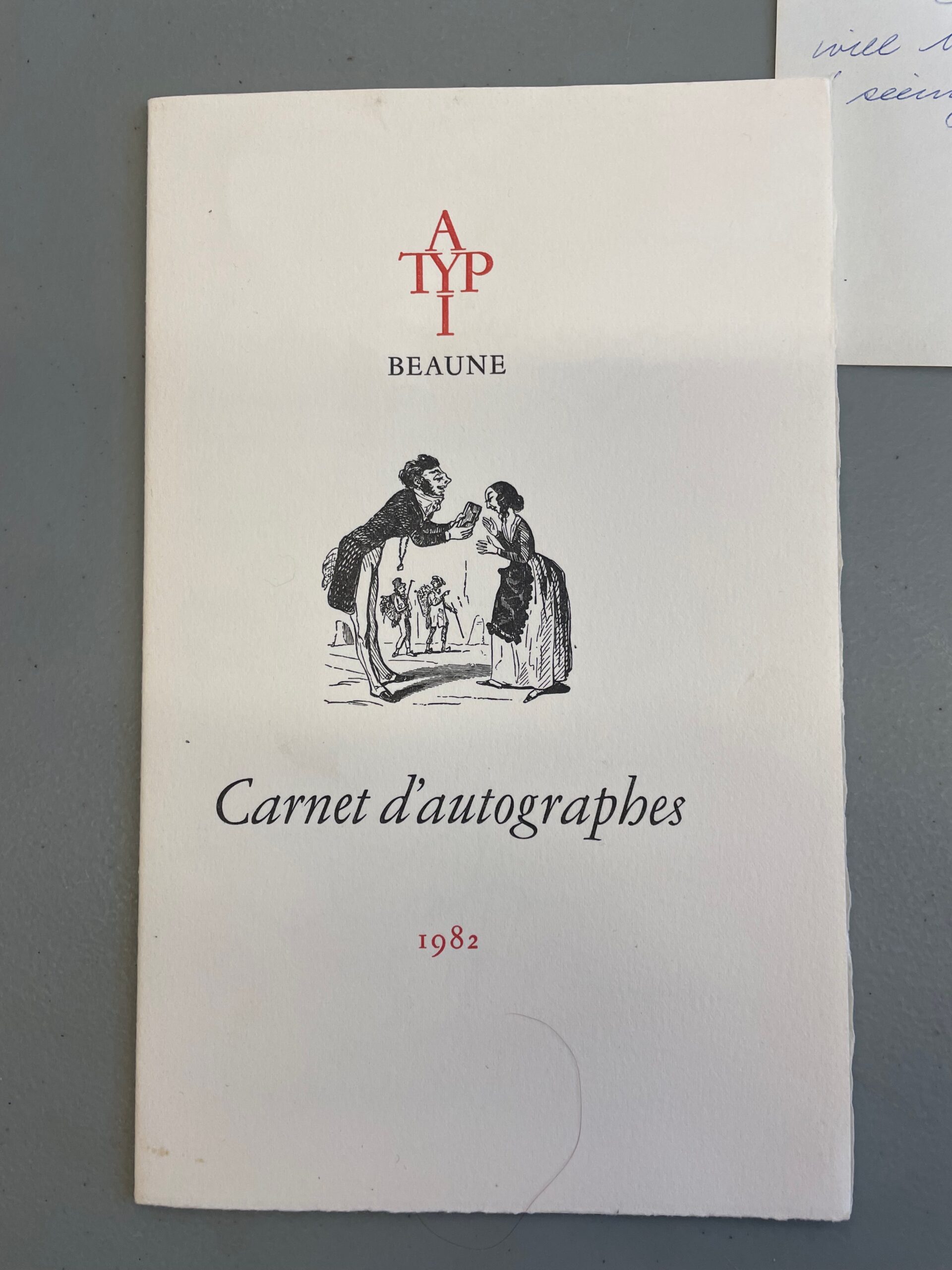
In 1982, on the 25th anniversary of ATypI’s founding, the association established the Prix Charles Peignot (the Charles Peignot Prize), an award that would be given every three years to a type designer under the age of thirty-five “who has made an outstanding contribution to type design.” The award, which included a cash prize, was named in honor of the founder of the association, Charles Peignot, who died the following year.
The first Prix Charles Peignot was awarded to French calligrapher Claude Mediavilla and presented to him at the 1982 AGM in Beaune. Thereafter, the prize was awarded triennially, although sometimes for various reasons there was a longer gap.
Beaune 1982
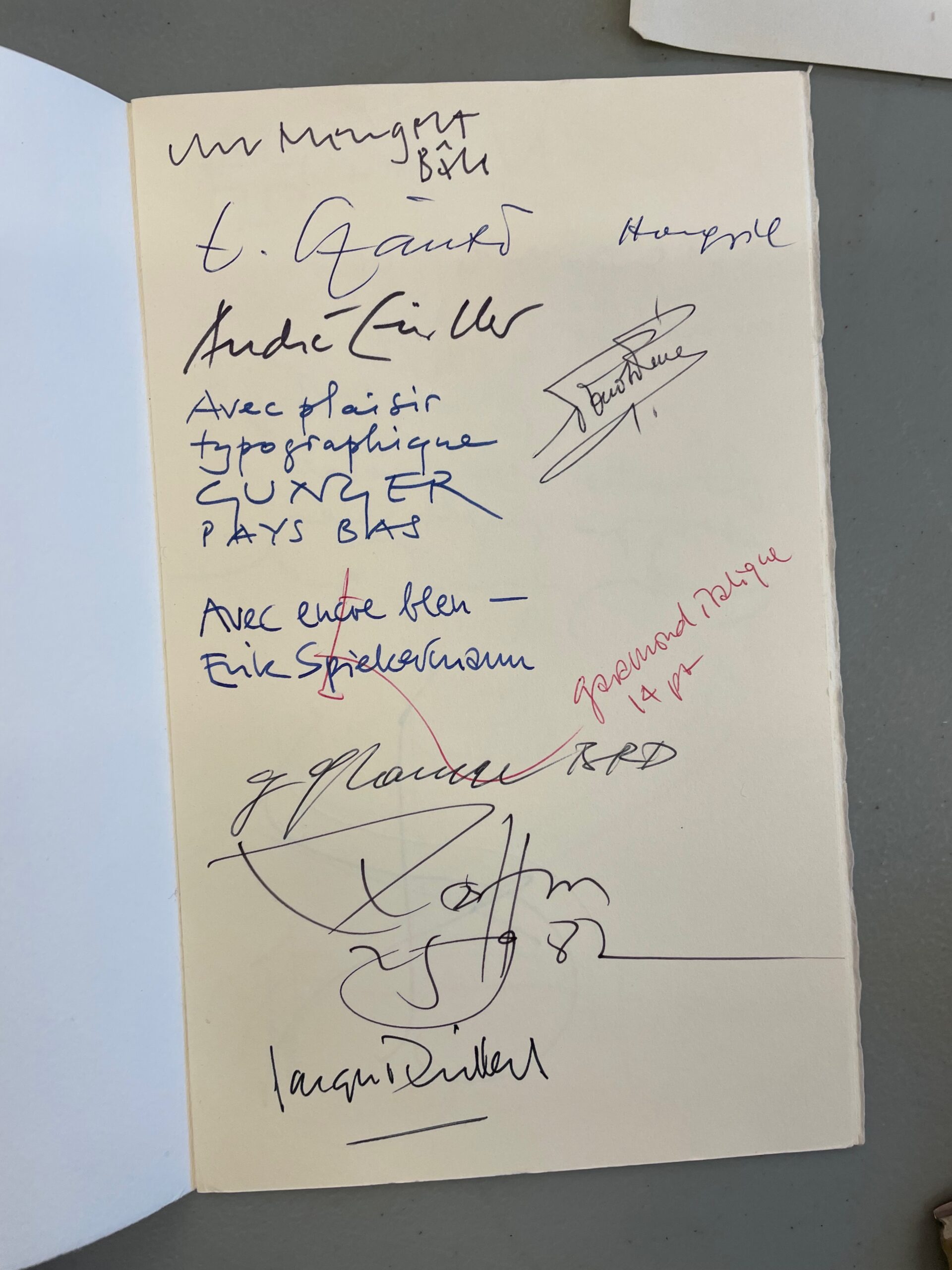
The 1982 congress took place in Beaune, in the heart of the Burgundy wine region in eastern France. It was organized by Nicole Croix and featured, not surprisingly, fine food and wine. The gala dinner was held in the Gothic vaults of the old Cistercian hospital, with an astounding buffet and progressively finer Burgundy wine. The event, as Roger Black recalls, was organized by a local typographer whose foundry was known for the old-style Latin types used on wine labels.
At each table there was at least one person unknown to the rest of the guests, who was assumed to be someone from Paris who was in the French type business. Black describes how at a certain point in the meal, the stranger at his table leaned close to Sarah Stephenson, of the Stephenson Blake foundry, and pulled a scarf from her ear. Then a string of beads. Then, finally, a white dove, which flew to a perch. It was a close-up magic show.
At other tables, the mystery guests were performing in various ways: dancing flamenco, drumming, juggling. The host, it seemed, had booked an entire troupe from the Crazy Horse Saloon in Paris for the event.
Zapf resigns from the Board (1986):
In a statement to the ATypI Board in 1986, Hermann Zapf announced his resignation from the Board, on the following grounds:
Since after the discussion of the Kelbel publication it was clear to me that I cannot stay longer with A TYP I. (No details about the Kelbel book, since we have no time for this today.) But during the last year I wanted to help Mr. Schmiedt in his PR proposal and getting especially Baudin’s project started. Full of hope I was for this year to get an arrangement in the licence matter, especially after receiving this excellent paper by John Latham. You should know this: As a designer I lost within all the years many D-Marks for licence fees from Linotype, as they refused my faces to be licensed to some other companies. But you can buy my faces even in Germany (from Compugraphic) and they don’t pay money to Linotype or the designer. I ask myself why I am still here. Last Thursday it was clear to me that Linotype is still not willing to change their licence policy. For me it is not a question of the antitrust law why we could not find an acceptable sentence to be added to the Code Moral of A TYP I. I think I have done enough for A TYP I since 1957, spending a lot of my time and energy to work within different committees. My work is done, want to resign today from the Board of Directors of A TYP I to be free for further decisions by watching the whole from outside.
The Board minutes concluded, “Hermann Zapf’s resignation from the Board of Directors will be announced to the General Assembly.”
Matthew Carter recalls:
Hermann resigned, at least once if not twice. He had a slightly different idea about the protection questions, because he reckoned that he was probably the designer whose work was most ripped off. By unscrupulous manufacturers. For which of course he got no royalties! So he said that Linotype should license his faces to these people, and he thought that they would be very happy to pay, in exchange for the use of the name – the right name, the trademarked name – and have a more authentic version of the typeface. And I think he was probably right. But Linotype didn’t want to do that. They said, ‘It’s our property, we’re not going to license this to Compugraphic or some other upstart – Autologic nonsense or something or other.’ So Hermann and Linotype were at loggerheads about that. Completely.
Zapf resigned from ATypI entirely, in 1993, in protest of Book Antiqua, the clone of his typeface Palatino that Monotype developed for Microsoft. Zapf and Microsoft later came to an agreement, and Zapf created a new authorized digital version, Palatino Linotype, for Microsoft.
Working Seminars
Swiss typographer Jost Hochuli found the ATypI Working Seminars more congenial than the annual congresses: smaller, more intimate, less formal.
For reasons I no longer remember, the next ATypI seminar didn’t take place until 1981, not two, but three years after The Hague, in Hofheim im Taunus, primarily organized by Hans Peter Willberg. We traveled extensively: to the Mainz University of Applied Sciences, to the Klingspor Museum in Offenbach, to the Stempel Type Foundry in Frankfurt am Main, and to the Gutenberg Museum in Mainz, and finally, together with the participants of the ATypI Annual Congress, on a Rhine cruise to Rüdesheim with a walk to the Niederwald Monument.
In Hofheim, too, I have a memory of Berthold Wolpe. We were all already sitting on the bus for one of the excursions when Wolpe suddenly got up, climbed out of the bus, and headed back to the hotel in unusual haste. He had forgotten his pipe, which he now held out to the waiting travelers as he returned. No one was angry; Wolpe was only known for smoking a pipe, and his apologetic smile was disarming. (Nicolas Barker later called this smile the most charming in all of London in an obituary.)
Gdansk 1988 | Seventh ATypI Working Seminar
Jost Hochuli:
Roman Tomaszewski had organized the event and prevailed against some resistance from the board of ATypI; they didn’t want to go to the communist East. And the seminar was almost canceled at the last moment, because things were once again simmering in the shipyards of Gdansk and Gdynia, and there were fears that the military would be called up, which would then have needed the premises of the Baltic Center east of the city as accommodation. The uncertainty meant that some things didn’t work out, and a lot of improvisation was necessary – but Roman, accustomed to the conditions in the East, always had a solution.
The days on the shores of the Baltic Sea were a strange experience for us from the West. We took trips to Gdansk, where Adrian Frutiger was robbed by Gypsies, and we visited Malbork Castle, an impressive brick building built in the 13th century on an estuary of the Vistula. It was in a visibly dilapidated state during our visit, but it still made a big impression.
London 1984
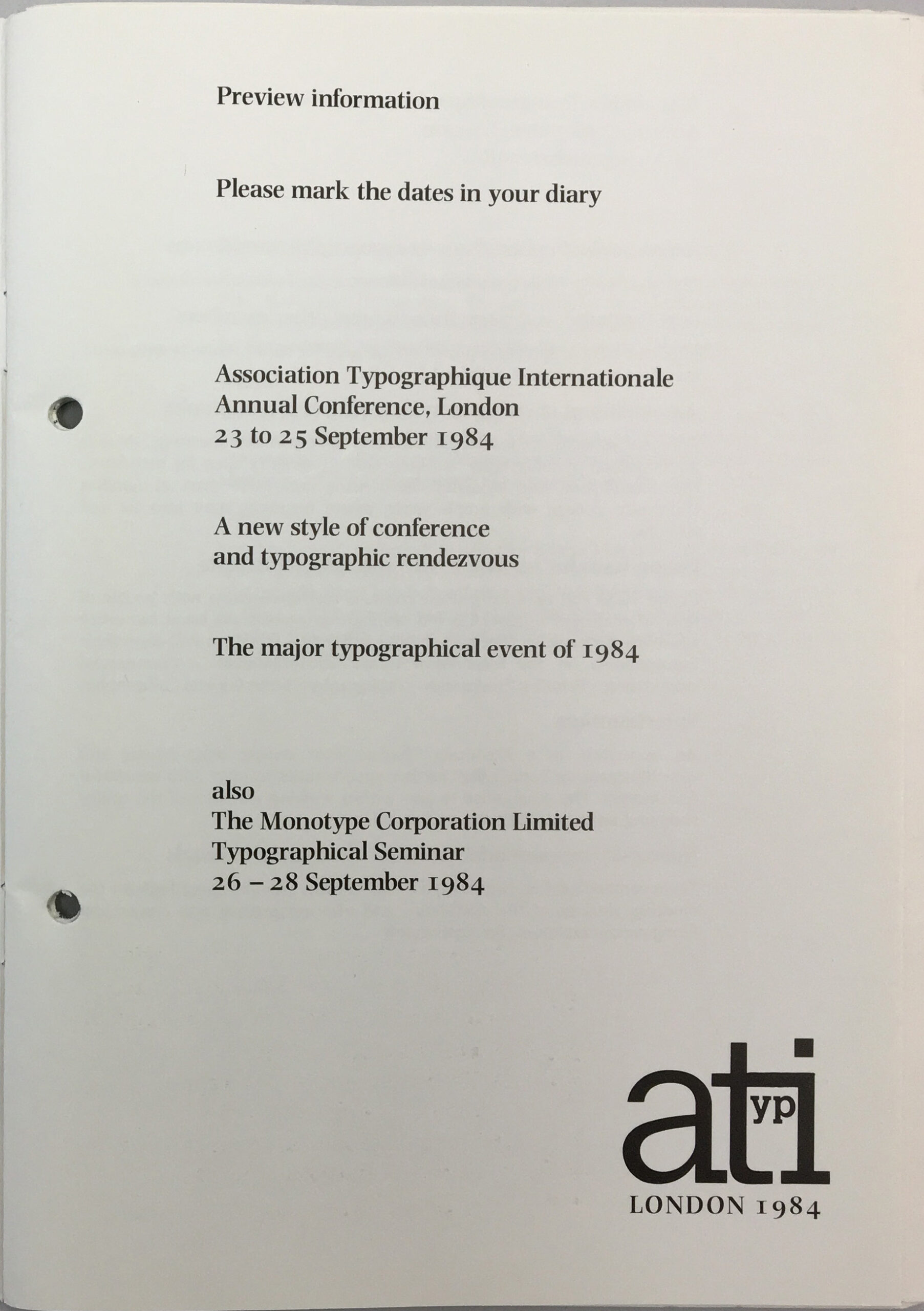
In 1984, ATypI’s annual meeting was hosted in London by Monotype, and instead of a congress it was called a conference. The organizers described it as “a new style of conference and typographic rendezvous,” featuring “less formality and more time to meet other members.” The promotional brochure bravely called it “the major typographical event of 1984.”
Alongside the conference itself there was an exhibition of calligraphy, lettering, and typography at University College London, “with ample space where members may also sit and socialise.”
Recognizing the changing technologies of type and printing, Monotype hosted a technical “typographic seminar” immediately after the conference.
This arrangement set the stage for a structure that would be used at many later ATypI conferences: the main conference flanked by exhibitions and either followed or preceded by a day of technical discussions.
Tellingly, the promotional brochure advertises an alternative to expensive hotels in central London: the University College London, site of the conference, would also offer accommodations in the college itself at a greatly reduced price.
Fernand Baudin
Jost Hochuli describes Fernand Baudin, one of the most active members of ATypI in the 1970s and 1980s:
One prominent member of ATypI was only encountered at the congresses: the Belgian Fernand Baudin. Since, until Type ’90, the German and English votes had to be translated for the French participants, Baudin usually took on this task; in addition to Flemish, he was fluent in French, German, and English. His “translations” usually included his own, often witty, commentary and usually caused a hearty laugh. Once, after a lengthy intervention by an Englishman and Fernand’s translation, a German speaker affirmed the exact same idea in tedious detail. Baudin said laconically: “Il a dit: oui.” In 1993, Fernand Baudin left ATypi after a dispute (I never found out why).
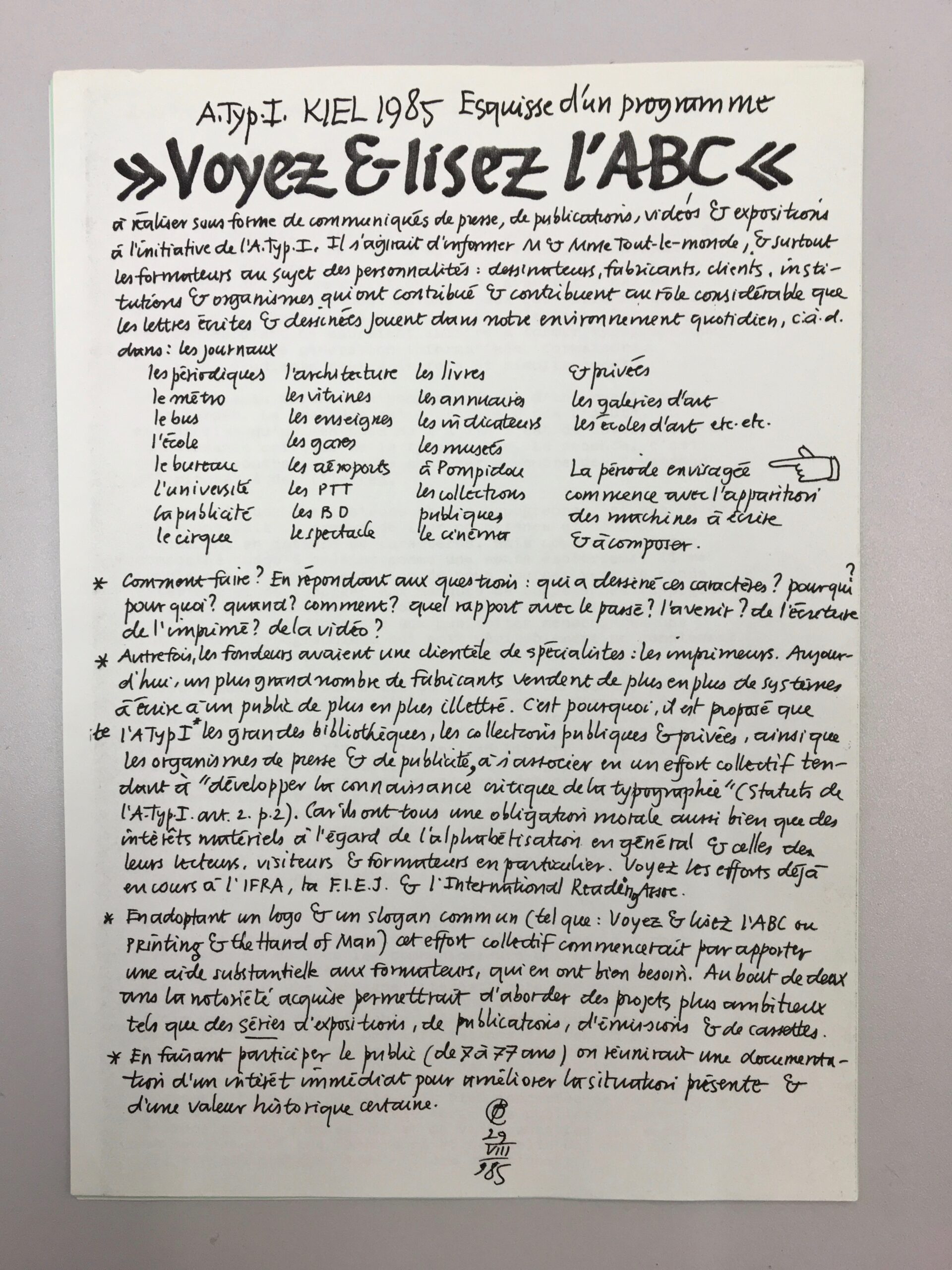
Fernand Baudin was an active and energetic member of ATypI for many years, and he was always passionately interested in educating the public about typography. (He was also noted for his exuberantly hand-written letters and documents.) His proposed “ABC Program” of typographic education was intended to “extend a critical knowledge of good typography among the public and, in particular, among educators, with the stress on fighting illiteracy in typography.” Baudin had a wide vision of what was needed, and of how ATypI could contribute to and lead this global effort. His provisional name for the undertaking was “Printing and the Hand of Man,” and he expended quite a lot of effort over several years in promoting it.
Structure of a congress | committees & AGM
In a letter to members dated March 12, 1986, secretary Roswitha Jung laid out the typical structure of an ATypI meeting in this period. She announced that the “Working Session with Annual General Meeting” would be held in Basel in September. It was to be a three-day gathering at the Hotel International, beginning on Thursday with a meeting of the Board of Directors, then a reception with drinks, and ending on Saturday with the AGM, followed by a lunch. In between, on Friday, the morning would be devoted to meetings of the three official committees: Type Manufacturers, chaired by John Latham of Monotype; Educators, chaired by Gerrit Noordzij; and Designers & Typographers, chaired by Matthew Carter, then of Bitstream. The afternoon would consist of a general forum, with the usual generous breaks for lunch and coffee.
Presumably the actual meeting followed this structure.
Type 1987 | Reaching out to new audiences
The desktop revolution raised the profile of type and typography in the general population. (It was sometime in the 1980s that I first overheard a random stranger talking on a bus casually use the word “fonts.”) In response, Roger Black had put together an ambitious event in New York called “Type 1987,” organized by the Type Directors Club; ATypI’s annual congress that year also took place in New York, though later in the year, and the impact of Type 1987 was clearly on everyone’s mind.
Roger had originally been working with ITC’S Aaron Burns with the idea that this would be an ATypI conference but much larger than the usual congresses. When Burns fell ill and had to drop out, the TDC stepped in to put it on as an independent event. ITC had a heavy presence, bringing their staff and designers such as Ed Benguiat.
In March 1988, Sumner Stone, who was then the Director of Typography at Adobe, and who had been involved with Type 1987, replied to a letter from Alfred Hoffman. “Thank you for your letter inquiring about Type’87 and ATypI’s participation in similar events.” Stone enthused over the breadth of focus at Type 1987, before concluding: “The most important thing, however, was that the speakers and workshop leaders were asked to do something that they were passionate about. The focus was therefore on people’s enthusiasm for type and typography.” From his own perspective as a pioneer of high-quality digital type, he added, “There is a particular need because of the new technology to help educate the people who are making decisions about typefaces and their use.”
The response to Type 1987 led directly to Roger Black’s proposal for an even more ambitious event, and a turning point for ATypI: Type90, the 1990 ATypI conference in Oxford, U.K.
Rumors of Font Wars
At the 1989 Seybold conference, when Microsoft and Apple made the announcement of their collaboration on TrueType as a competitor to Adobe’s PostScript fonts, they launched what came to be called the Font Wars. But that is largely a tale for the 1990s.