


Leipzig 2000
At the cusp of the millennium, ATypI returned to what had once been Eastern Europe and was now part of the reunited Germany: Leipzig. At the turn of the previous century, Leipzig had been the heart of Germany’s printing and publishing trade, with 200 publishers in the city and an annual trade fair that dominated the industry. Even after the country was divided, Leipzig served as a center of typography and printing for the countries of the Eastern bloc.
After the fall of the Berlin Wall and the reunification of Germany, Leipzig was showing the signs of the sporadic boom of capitalism, and tensions between old-time residents and new arrivals with lots of money were readily evident. Empty, run-down, or boarded-up buildings stood next to chic new restaurants in titanium and glass. But the student culture was vibrant, ready for new things; as Günter Bose, a professor at the Hochschule who had spent ten years as a publisher in Berlin, said, the students in Leipzig had “the fire, the need to make something,” in contrast to his students in Berlin.
The 2000 ATypI conference reflected the divided/united culture of Germany, organized by Berlin-based Erik Spiekermann, of MetaDesign and FontShop, and Leipzig-based Eckehart SchumacherGebler, head of the local printing museum (Werkstätten und Museum für Druckkunst). SchumacherGebler had established the museum and its workshops in the former premises of the Offizin Haag-Drugulin printing house, where he worked hard to preserve the typographic legacy of the German Democratic Republic (DDR).
On the opening evening of the conference, attendees trooped over to the Hochschule für Grafik und Buchkunst, where the New York Type Directors Club would be presenting its TDC Medal to Günter Gerhard Lange, long-time artistic director of the Berthold type foundry. As I wrote in a report on the conference:
As we made our way through the impressive entrance hall of the Hochschule, we typophiles kept halting and swirling in eddies to get a good look at the typographic rarities on display in a series of glass cases set up on either side of the hall. There was no time to do them justice, but we gazed down briefly and appreciatively at examples of books, design sketches, and printed ephemera by some of the best-known typographic designers of the 20th century.
The typographer and teacher Albert Kapr (d. 1995) had founded the Institut für Buchgestaltung here in the 1950s and presided over it and the school for decades. As we walked in, London typographer Colin Banks, reflecting on this and Leipzig’s long typographic history, looked around at the displays and the school and mused, “We stand on hallowed ground.”
The TDC event was also an occasion to present one of the TDC’s scholarships to a student at the Hochschule, Philipp Arnold, who then confounded GGL by presenting him with a typographic catchphrase incarnate: the quick brown fox that so famously jumps over the lazy dog. That pangram, which uses all the letters of the alphabet, had figured in innumerable Berthold type specimens that Lange had designed.
In this case, the fox was not so much quick as dead – stuffed, in fact, and mounted. The red fox had adorned a shelf in the school for quite some time, apparently, and the students felt that it was time it went to live with Herr Lange. Getting into the spirit of the thing, Lange draped the fox’s bushy tail over the shoulder of red-haired Carol Wahler, the TDC director, as she made a concluding remark and urged the audience to stick around for some Saxon red wine and snacks before the upcoming ATypI auction.
Since the world’s first daily newspaper had been published in Leipzig, in 1650, it seemed entirely appropriate to find an enormous display of printed newspapers dominating the equally enormous Leipzig central train station during the conference.
There were events in historic venues, such as a reception in the Moritzbastei and a gala dinner in the Auerbach Keller, immortalized in Goethe’s Faust. But in many ways the highlight of the conference was a pop-up student bar created just for ATypI, called “type is sexy.” Some of the graphic-design students from the Hochschule had turned a downtown storefront, which was in the process of being renovated and would eventually open as a boutique, into an impromptu destination. Bare white-washed walls, a simple bar, loud music, and on one wall a continuous loop of the credits to the James Bond film Goldfinger set the stage. Software geeks and wizened type pros got down to the beat, and the students who organized this watched in bemusement as the international typographic elite danced themselves into a sweat and got seriously silly.
Along with the expected panoply of historical and technical presentations, the program included intense discussion of OpenType and how it would be supported both in print and on the Web.
There was one unfortunate event at the conference. During the AGM, when new members are elected to the Board or current members re-elected, it turned out that there was one more candidate than there were open Board seats. This meant that the election was like a game of musical chairs, where there’s always one less chair than there are players trying to sit on them. As I was one of the newly elected members (Mark Batty had encouraged me to join the Board that year), I promised myself after the AGM that I would do what I could to make sure that this unintentionally cruel situation never arose again: we would have either exactly as many nominees as there were open positions, or significantly more.
Copenhagen 2001
The following year’s conference in Copenhagen had to contend with a shocking world-historical event: the destruction on September 11 of the twin towers of the World Trade Center in New York. This took place just two weeks before the scheduled conference. It meant that many people who had planned to attend, especially Americans, had to cancel their plans. But those who managed to make it found the people of Copenhagen, including Middle Eastern shop owners, appalled and sympathetic to the visiting Americans.
The management team issued public statements assuring both attendees and the conference sponsors that the conference would go ahead, despite the circumstances. This was important not only on principle but financially. Sharon Moncur, whose team managed running the conference, remembers: “60% of the conference income came from American sponsorship, 90% of which hadn’t yet been received, so keeping the ship on course was particularly important.”
The local organizers were Henrik Birkvig and Torben Wilhelmsen. ATypI’s first website was being created at this time, but Torben put together a separate website just for the conference, and he made an animated logo for it using Flash.
The program ran in three parallel tracks on the first day, and two tracks after that. “That was too many,” said Henrik, thinking back, when interviewed at the 2025 Copenhagen conference. The Font Technology Forum featured presentations on Unicode and OpenType, while an “e-book seminar” examined the state of play in typography for digital books. Talks on Danish and Swedish letters in the 20th century ran opposite the “Type Grocery” track, where proprietors of small independent font foundries showed off their work, their business models, and even their studios.
For some time before the conference, Henrik and Torben had been running an informal program of visiting speakers, which they called the Cooper Black Club. They had used this as a way to raise awareness of the upcoming conference and at the same time to recruit program participants. The Cooper Black Club continued for a while after the conference, but eventually “it sort of faded out.”
The gala dinner took place at Basecamp, a converted cannon factory and “Copenhagen’s coolest club venue.”
bukva:raz!
At the Leipzig conference in 2000, President Mark Batty had announced ATypI’s first international type-design competition, under the title “bukva:raz!” (“book:one!” in Russian). The organizers of the competition were Maxim Zhukov, typographic advisor to the United Nations in New York, and Vladimir Yefimov, principle designer at ParaType in Moscow. The deadline for submissions was in 2001, and they could include any type design, in any language or writing system, released in the previous five years.
The United Nations had declared 2001 the Year of Dialogue among Civilizations, and bukva:raz! was ATypI’s response to this initiative. As Mark Batty explained it:
We wanted to find a way to promote cultural pluralism, encourage diversity, and provide a co-operative environment for the development of truly international typographic communications.
This goal and expansive reach seemed all the more important in the face of the destructive events of September 11, 2001.
Judging took place in Moscow in December of that year, at the UN Information Center in the center of the city. The international panel of judges comprised Matthew Carter, Yuri Gherchuk, Akira Kobayashi, Lyubov’ Kuznetsova, Gerry Leonidas, and Fiona Ross. The judges had two days to winnow down 600 entries to a set of 100 winners.
The next year, ATypI published a book, in cooperation with Graphis, Language Culture Type: international type design in the age of Unicode, showing each of the 100 winning bukva:raz! entries in its own page spread, along with eleven essays by diverse writers on aspects of type design for various languages and scripts. The first two essays complemented each other: Robert Bringhurst created what he called a taxonomy of language for his “Voices, languages, and scripts around the world,” and John Hudson gave a clear, well-illustrated explanation of the Unicode character-encoding standard and how it makes exchanging text in multiple writing systems practical. I edited the book and managed the project, Maxim Zhukov designed it, and John Hudson handled typesetting (using an unreleased version of Adobe InDesign that made it easier to manage some of the multi-script requirements).
The newly published book was distributed to all the attendees of the 2002 conference in Rome.
Rome 2002
The 2002 conference was organized by American lettering artist and type designer Garrett Boge, who had been spending part of each year in Rome doing research on inscriptional letterforms, and who with Paul Shaw had led several lettering tours of ancient, medieval, and Renaissance Rome. The theme of the conference was “The Shape of Language.”
Originally, Boge’s plan was to have the conference take place in the renovated buildings of what had once been a slaughterhouse in the colorful Testaccio neighborhood. The problem was that the renovation had not yet been completed, and although it was scheduled for completion well before the conference dates, the Board was skeptical and risk averse. So instead of an inner-urban location, ATypI 2002 took place on the outskirts of the city, in EUR, the overbearing exhibition town that had been begun by Mussolini and completed after World War II. It was a functional venue, replete with several thought-provoking examples of Fascist architecture and inscriptional lettering, but it was a far cry from the happy chaos of Rome.
The program ran in several tracks, including an entire track in Italian called the “Italian Design Forum” and a “Multi-Lingual Typography Symposium.” Since these were running concurrently with the main program, they tended to break up the audience by its preferred interests.
There were three keynote speakers: Giovanni Lussu, one of the most respected figures in Italian type and graphic design; Paul F. Gehl, curator at the Newberry Library in Chicago; and handwriting expert Rosemary Sassoon.
In 2002, the heavy emphasis on Italian graphic design and typography brought in a large number of student attendees, but the organizers hadn’t reckoned with the financial effect of so many unpaid participants. This was one instance of how, although the Rome conference was a fabulous success for those attending, it was fraught with worries for those behind the scenes. While attendees were happily sipping espresso and prosecco and enjoying tasty antipasti outside the program rooms, the Board of Directors and the organizers were wrestling with contentious practicalities. This kind of disconnect between the public face of a conference and its behind-the-scenes private face isn’t uncommon, but at the Rome conference the contrast was unusually strong.
As British typographer and educator Phil Baines wrote in a post-conference report:
Since January 2001, ATypI’s worldwide membership has had the advantage of its own email list to share views, experience and advice. This has proved a benefit to a membership which at times resembles a large family gathering (in all the best senses of the term), rather than an association of business people. However, nothing beats meeting like-minded people from around the world and sharing those views, experiences and advice first-hand.
Exhibitions included the winners of the bukva:raz! competition (winners’ certificates were awarded during the AGM) and the annual Type Directors Club competition, as well as exhibits of Italian design, rubbings taken from stone inscriptions around Rome, and treasures of the St Bride Library in London.
One of the most entertaining highlights was a lettering “duel” between Cynthia Batty and John Downer, held in the main auditorium during the lunch hour one day. There was no rancor involved; it was, rather, a question of technique, and of interpretation of the writings of Father Catich, the Iowa sign-painter who claimed to have figured out how the lettering on the Trajan column was originally created, and where the serifs came from. Both skilled calligraphers, Cynthia and John demonstrated their preferred techniques, questioning, with wit and flair, the cherished assumptions about how public lettering had been practiced in antiquity, and engaging the audience in a lively back-and-forth. No serifs were harmed in the making of this duel.
Associate memberships
As the reach of ATypI became wider and members came from many different countries around the world, the Board struggled with the question of how to make membership more affordable to people in economically disadvantaged countries. Should everyone pay the same rate? Should there be a graduated system, based on a country’s economic status and currency value? What were the perks of membership? ATypI had started out as an association of manufacturers and associates from the affluent countries of western Europe; it was no longer limited to that scope.
In 2003, the Board voted to establish Associate Member rates, but the debate continued: which countries should qualify for Associate Member rates? Wouldn’t that be like making everyone from certain countries into second-class citizens?
There was no simple answer. In 2011, Adam Twardoch researched the question and proposed a new tiered system. This lasted for a few years.
Vancouver 2003
In 2003 ATypI returned to North America, this time to Canada rather than the United States. The conference was split between the main conference hotel, the Westin Bayshore in downtown Vancouver, and the Emily Carr Institute of Art + Design, on Granville Island, just across False Creek from the center of the city. This reflected a changing emphasis: for several years the conferences had been held in expensive hotels with major conference facilities, but in 2003 the Board chose to pivot toward less expensive educational institutions as venues. That year, because of prior commitments to the hotel, it was a mix of both.
The theme was “Between Text & Reader,” and co-organizers John Hudson and Ross Mills put together a densely packed, tightly interwoven program of talks and panels and demonstrations that all focused on that undefinable but crucial space between the text and its reader. Keynote speaker Robert Bringhurst focused on “The tangibility of meaning,” explaining that in pre-printing days everyone who read also wrote, and thus they knew what the letters felt like in their own hands. There were talks about the design of books, about the design of newspapers, about the design of information, about the design and use of typefaces in Arabic, Hebrew, and Chinese, and, most notably, about legibility and readability – a subject that caught everyone’s imagination and served as the yeast in many conversations throughout the week.
One of the features of ATypI conferences in that era was the benefit auction, to raise money for the association and the costs of putting on a conference. There was always an open bar throughout the auction, to get people loosened up so they’d part with their money. This year the auction fared particularly well, with more collectible items and more income than at any previous ATypI auction.
2003 reorganization
“As the type world moved away from the heavy corporate sponsorship of previous years, so the finances became less secure.” This was the assessment of Sharon Moncur, looking back on the period when her business ran the Secretariat of ATypI.
In 2003 the financial strains on ATypI included the unexpected costs of the Rome conference and the ongoing uncertainty about the ultimate costs of managing a lawsuit. As a result, Mark Batty sent the Board a “Survival Plan for ATypI,” in which he outlined ten issues that would have to be dealt with.
It was no longer feasible to continue hiring Sharon Moncur’s services to manage the association and the conference. As a temporary measure, Cynthia Batty took over as Executive Director and as conference manager for Vancouver, working to ensure that the costs of the conference would be kept as low as possible without cutting into the quality of the experience and that income from the conference would be adequate to fund the association. Members’ dues no longer paid the bills.
These efforts were successful, but the situation led some of the Board members to feel that a fundamental change in direction was needed.
ATypI was wrestling with technological changes as well as changes in the business of type. As Mark Batty wrote to the Board, explaining that it was time to “re-establish the needs of ATypI members”: “The industry continues to shift, as do the players who make up the membership of ATypI.” The association now had a functioning website, but it still took some effort to set up a system for paying membership dues and conference fees by credit card on the website. An online members’ discussion list had finally been set up, and members were participating very actively, exchanging news and arguing vociferously about what ATypI should be.
Both Adobe and Microsoft held two-day technical workshops immediately before the Vancouver conference on the challenges and opportunities of OpenType. The outdated Statutes had no provision for remote meetings; there had been no such thing as the internet when the Statutes were written, decades before. The Code Moral seemed like a wistful document that no longer served any practical purpose, if indeed it ever had. The disconnect between the assumptions that ATypI had started out with and the realities of the type world in the early 21st century was becoming clear.
Prague 2004
Over the course of the year, tensions had arisen within the Board and the membership. Some argued that ATypI had outlived its original purpose, and that it should therefore either shut itself down or change its focus and its management structure to reflect new realities. This was the time when an effort was made to update the Statutes and when the decision was made to eliminate the Code Moral as a dead letter.
In Prague, at the end of his term, Mark Batty stepped down as President and the members elected French type designer Jean François Porchez to be the new ATypI president. As Jean François said, he was doing this as part of a collective effort; he considered himself just the point man for the newly engaged Board members with a mandate to rejuvenate the old association. John Hudson, one of those engaged members, was elected as Vice President.
Prague was a perfect location for a conference with the theme “Crossroads of Civilizations.” In the fifteen years since the fall of the Berlin Wall, Prague had returned to its roots as a cosmopolitan city, set in the heart of Europe, making connections both east and west. It is also one of the few Central European cities that did not suffer heavy damage in World War II. (As Berlin typographer Erik Spiekermann remarked, “This is what our cities would look like if we hadn’t started a war.”)
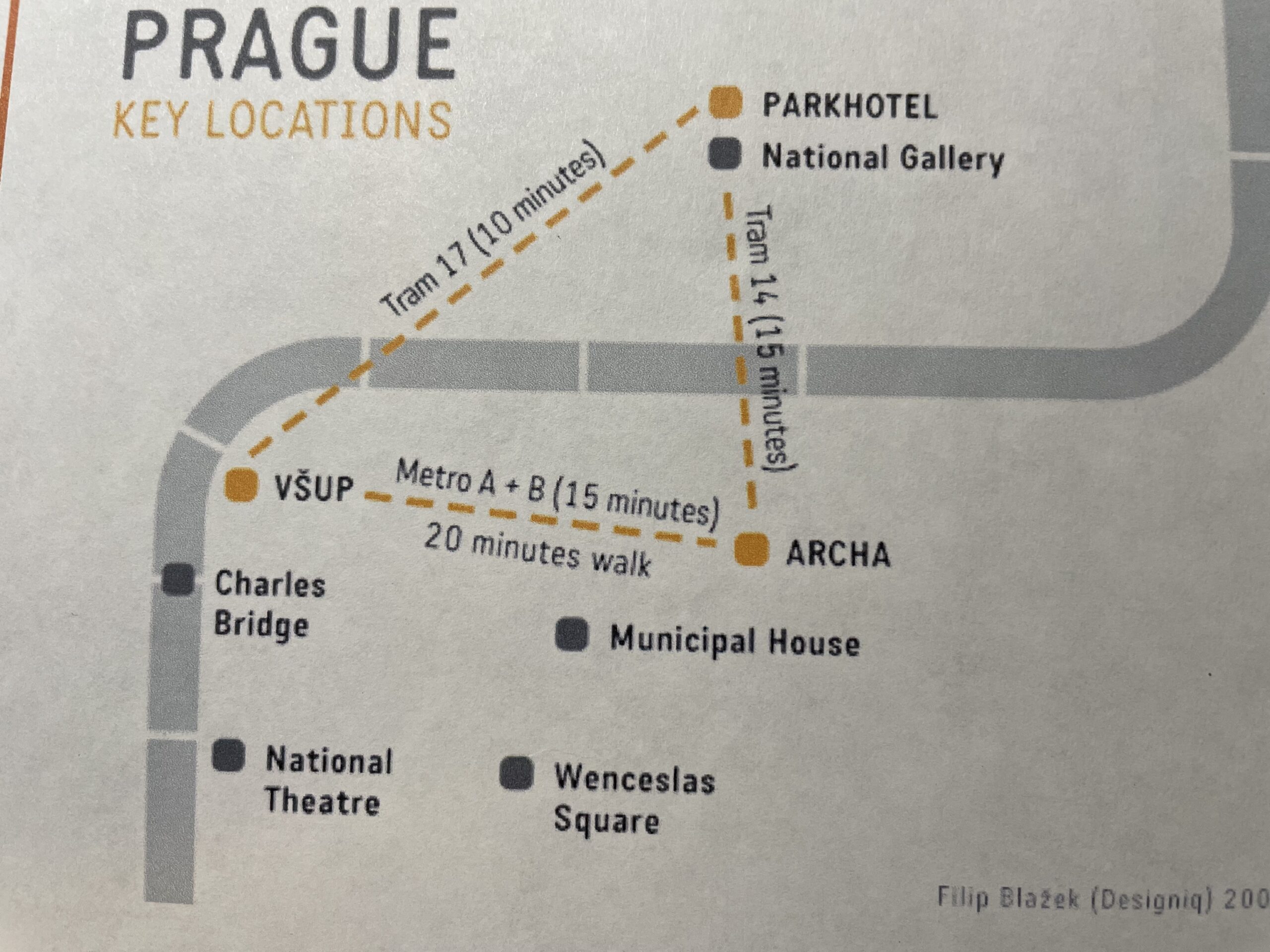
The contrast between old and new was embodied in the venues. The main program took place in the avant-garde underground Archa Theater, while an opening reception was held almost across the street, among the elaborately decorated ceramic walls of the 1914-era Café Imperial. There was a heavy emphasis, of course, on Czech typography and visual design, and the conference was enthusiastically supported by students from VŠUP (the Academy of Arts, Architecture, and Design Prague), who put on a very crowded and noisy “Kerning party.” There were talks on legibility, newspaper design and typefaces, “world types,” Cyrillic types, the design of diacritical marks, and notable Czech type designers Josef Týfa, Oldřich Menhart, and Vojtěch Preissig. Keynote speaker Rick Poynor sparked quite a bit of controversy with his talk, in which he both encouraged Eastern European designers not to sell out to Western commercialism and acknowledged that if they didn’t, they’d be stuck in poverty. The Q&A period went on for 45 minutes at the end of his speech.
The gala dinner this year was held at the Břevnov Monastery, a building in the Baroque style although the monastery dates back to 993.
At the TypeTech Forum, which preceded the main conference, Microsoft announced its new suite of ClearType fonts, multilingual fonts designed for reading clarity onscreen, and distributed a 72-page book on the project, Now read this: the Microsoft ClearType font collection, in the goody bags.
TypeEvents
In April of 2005, Cynthia Batty stepped down as Executive Director and the Board appointed a new collective Secretariat. Typevents was a newly formed partnership of five typographic professionals (Caroline Archer, Shelley Gruendler, Simone Wolf, Alexandre Parre, and Melody Strange) with a primary office in the U.K. but based in three different countries. The Board felt that their knowledge and experience in the typography field would be a good fit for ATypI.
Typevents managed the association and the next two conferences, though the multi-headed nature of the company turned out to be hard to work with, despite everyone’s best efforts.
Helsinki 2005
The Helsinki conference was held at the Media Centre Lume, on the campus of UIAH (University of Art & Design), with an opening at the Helsinki City Hall, and copious social interaction at the Jazz bar. The opening reception featured a small triumph of Finnish design: clip-on wine-glass holders that attached to the plates.
The conference’s logo, designed by Underware, was notable for its animation: from a fairly staid sans-serif italic, it sprouted floral appendages and gradually morphed into an explosion of flowers. (The static version was a mid-point of this evolution, decorative but readable.)
The keynote speaker was Aaron Marcus. The program was notable for the number of presentations about multilingual and non-Latin type, as well as for investigations of emerging technology.
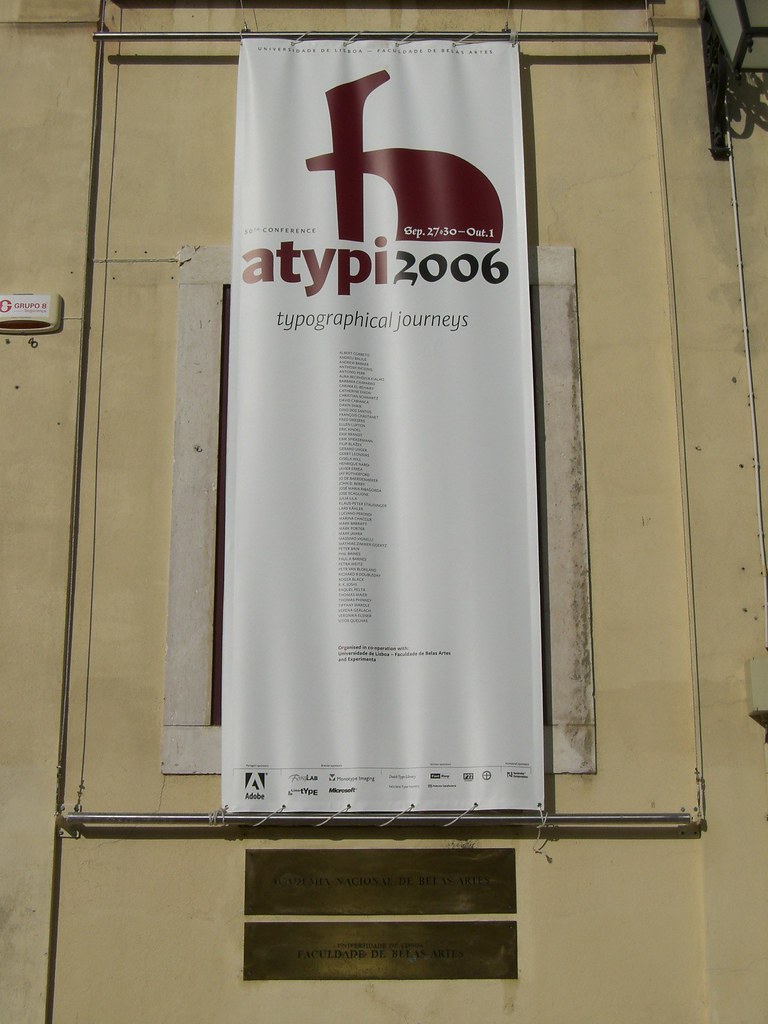
Lisbon 2006
ATypI Lisbon 2006 featured a number of specialized presentation threads and forums, all included in the four tracks of the main conference program: “The Business of Type,” moderated by Carima El-Behairy; “The Typography of the Journey,” moderated by Maxim Zhukov; “Newspapers and Type,” moderated by Mark Barratt; and “Education in Type,” moderated by Gerry Leonidas.
Not surprisingly, given their shared Portuguese language, Brazilian type and typographers had a strong presence in Lisbon.
The conference venue was the Faculdade de Belas Artes of the University of Lisbon, in the hilly Chiado district, between the rectangular Baroque streets of Baixa and the uptown district of Bairro Alto. There was no official conference hotel, but the unofficial one was the Hotel Eden, which had formerly been a grand movie theater. Another theater, the Cinema São Jorge, provided the venue for the opening reception; and the gala dinner, on the last night, took place in the elegant and historic Casa Alentejo. During breaks from the program, the long patio/balcony alongside the main building served as a constant meeting ground.
Keynote speaker Ellen Lupton’s arrival was delayed by 24 hours when her flight from the U.S. was canceled, and Erik Spiekermann was drafted at the last minute to give a talk in her place. Once she did arrive, she gave a talk about her “Free Font Manifesto,” which raised the question of how open-source fonts differ from illegally copied fonts, and in particular how open-source fonts can expand the typographic possibilities for underserved scripts and languages.
In the newspaper track, Roger Black spoke about custom fonts for newspapers and made the attendees aware of the upcoming possibilities of online newspapers.
Local organizing was handled almost single-handedly by Portuguese type designer Mário Feliciano, with assistance from Experimenta and FBAUL.
Lisbon is a city of tiles, and of magnificent graffiti. Attendees photographed lots of signs, graffiti, tiles, and steep, hilly streets. As if to complement the graphic-design aspects of ATypI, there was citywide celebration of light, called Luzboa (a pun on the city’s name and the Portuguese word for light), that lit up many of the main streets in red, green, and blue – i.e., RGB colors.
The conference logo was a witty use of a paragraph mark as ship’s sail, illustrating the “typographical journeys” theme.
Lisbon was the first conference managed by new Executive Director Barbara Jarzyna.
Brighton 2007
The Brighton conference, organized by Bruce Brown, Dean of the Faculty of Arts at the University of Brighton, was something of a response to Brighton’s rivals at the University of Reading, which had hosted the ATypI conference exactly ten years before.
Brown had an ambitiously complex plan for how the conference would run: three parallel tracks of programming, but punctuated periodically during the day by what he called “plenary sessions,” where all of the attendees from the three tracks would convene in the central auditorium for a single event, then disperse again to three tracks for the next program items. It would have worked if the three venues hadn’t been so dispersed within the university building, and if the schedule had allowed more time to get from one place to another, and if the running time of each item had been rigorously controlled. Unfortunately, none of these conditions were met, and the result was a certain amount of confusion and chaos.
At the Brighton conference, Jean François Porchez stepped down as President and I was elected to succeed him.
St. Petersburg 2008
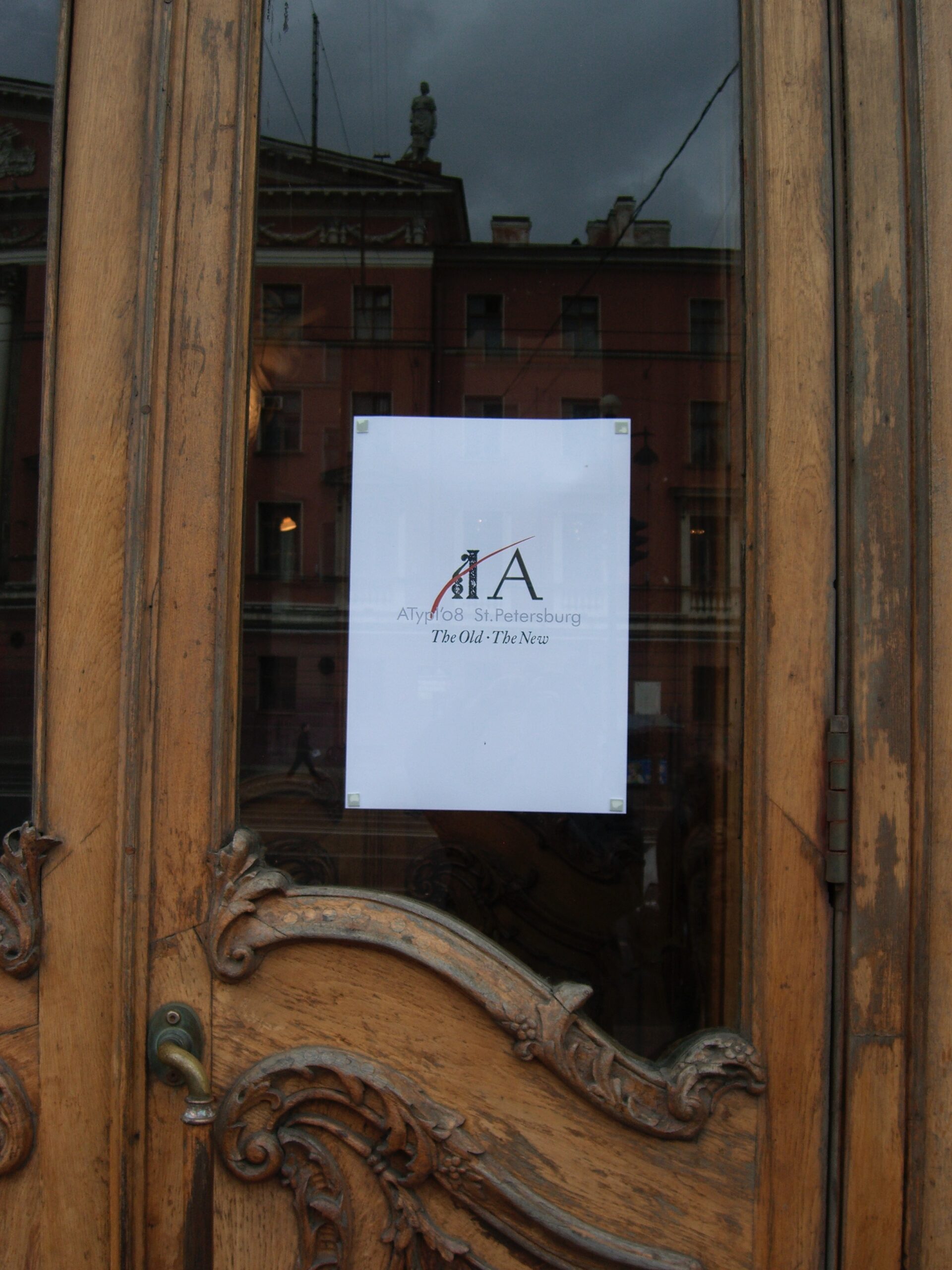
The year 2008 marked the 300th anniversary of Peter the Great’s introduction of Civil Type, a radical revision of the Cyrillic alphabet to bring it more closely in line with the Latin alphabet used in Western Europe. To mark this anniversary, ATypI went to St. Petersburg, Russia’s second city and Peter’s former capital. It was organized by ParaType, the pre-eminent Russian digital type foundry, with significant official support.
The conference’s two venues embodied the way historic buildings of quite different kinds can get re-used, and an aspect of the conference’s theme: “The Old · The New.” The main program took place in the Beloselsky-Belozersky Palace, known as the “pink palace,” a grand 19th-century building with a faux-Rococo façade, elaborate interior decoration, and creaking wooden floors. The technical workshops, exhibits, and parties were located in a converted Soviet bread factory, now an arts complex, about a mile away.
A highlight of the conference was a field trip to the National Library of Russia, where attendees got to see historic Russian books and documents, including examples of Russian printing from both before and after the advent of Civil Type, and Czar Peter’s own mark-up of the alphabet’s changes from old to new. Maxim Zhukov provided knowledgeable commentary throughout the visit.